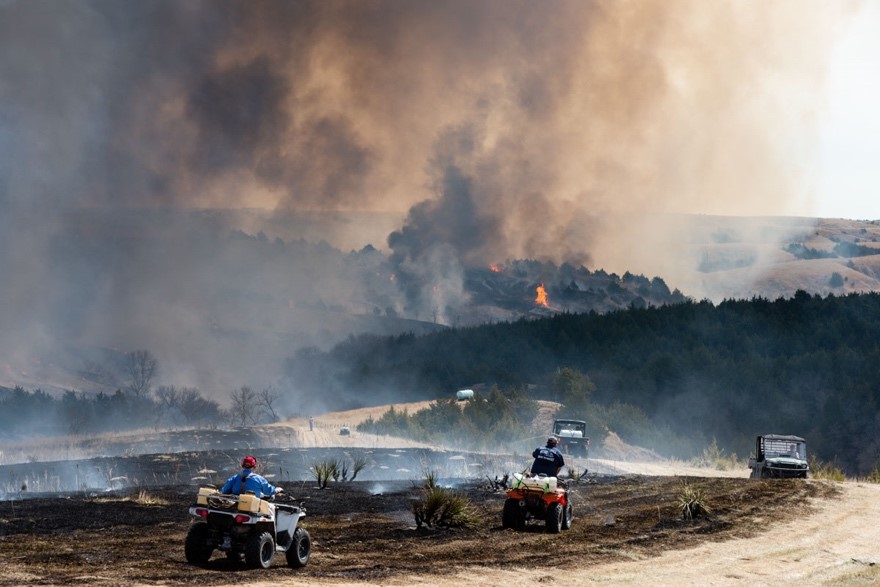
Photo credit: Nebraskaland Magazine/Nebraska Game and Parks Commission.
By Holly K. Nesbitt, Alexander L. Metcalf, Theresa M. Floyd, Daniel R. Uden, Brian C. Chaffin, Sabrina Gulab, Simanti Banerjee, Sechindra Vallury, Samantha L. Hamlin, Elizabeth Covelli Metcalf, Dillon T. Fogarty, Dirac Twidwell, and Craig R. Allen.
In a study on rancher behaviors in Nebraska, we found that social networks are more related to conservation behaviors than risk perceptions and ecological change to grasslands. Using survey and landcover data, we found that ranchers with contacts in other professions, ranchers from tight-knit ranching communities, and ranchers involved in rangeland management groups were more likely to use prescribed burning to manage encroachment of juniper onto grasslands. However, ranchers experiencing severe encroachment or who perceived risks of encroachment to ecological integrity and economic productivity of rangelands were not more likely to use prescribed burning. Taken together, these results suggest that ranchers understand the risks of encroachment but are hindered by a lack of social support to use prescribed burning on their operations. Juniper encroachment threatens to transition the Great Plains biome from grasslands to woodlands, affecting species who need grassland habitat to survive and ranchers who rely on grasslands for range. Actions that foster connections among ranchers and to contacts with diverse expertise may provide the support necessary to enable voluntary actions like prescribed burning on private lands. In contrast to other conservation behaviors to manage juniper, prescribed burning has the potential to limit the pace and extent of this encroachment at a landscape scale.
 Relational Thinking