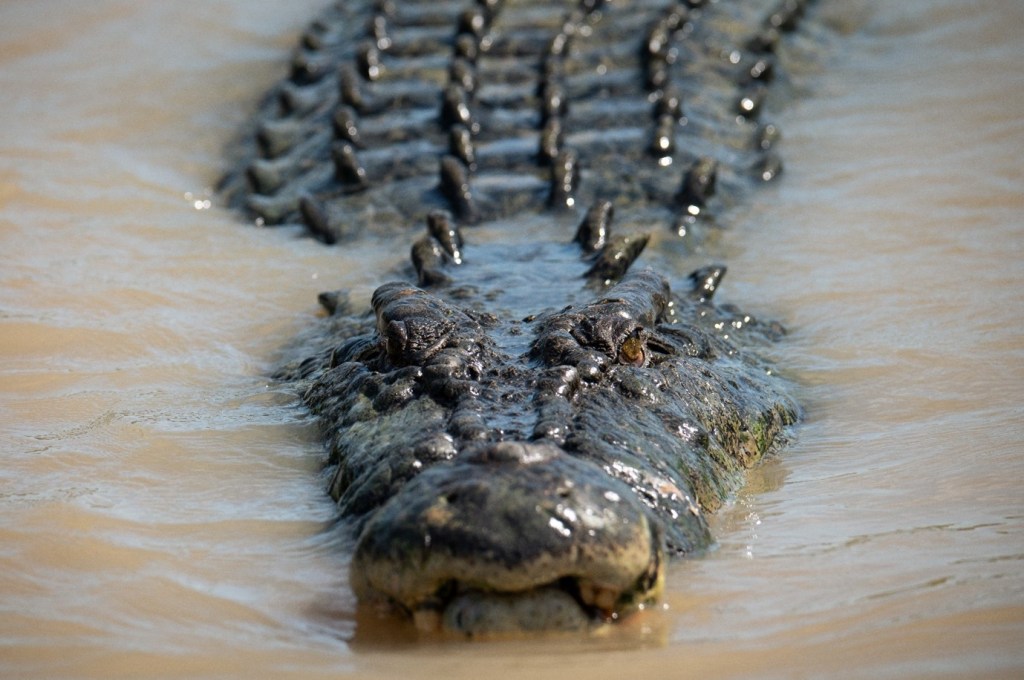
Photo credit: Cameron J. Baker
By Cameron J. Baker, Mariana A. Campbell, Vinay Udyawer, R. Keller Kopf, and Hamish A. Campbell.
Conserving and living alongside large predators is challenging, as large predators pose a threat to the lives and livelihoods (through livestock predation) of the people living alongside them. Although rare, large predator attacks attract intense media and public attention, reinforcing negative attitudes. Reactive political and public appeals to cull predators are also common. While it seems logical that fewer predators would reduce the risk of attack, little evidence supports a link between large predator density and attacks on humans.
Our study assessed the effectiveness of predator culling for human safety by examining whether estuarine crocodile (Crocodylus porosus) density was correlated to crocodile attack frequency in the Northern Territory (NT), Australia. Following legal protections in the 1970s, the NT estuarine crocodile population recovered from only a few thousand to over 100,000 non-hatchling individuals. We monitored this recovery, allowing us to examine how attack frequency changes over a range of crocodile densities. We found an initial increase in attack frequency as the crocodile population grew. However, this trend did not continue, and despite increases in crocodile and human populations, there has been no detectable increase in attacks. The attack frequency plateaued after 30 years despite crocodile population growth and expansion towards most NT waterways. This change appears to have been due to human behaviour adjustments around waterways, government initiatives to prevent crocodile attacks (for instance, education programs, removal of especially bold individual crocodiles, exclusion of crocodiles from urban centres), and crocodile saturation within the environment (that is, the risk of attack is similar whether there are one or ten crocodiles in a waterbody).
Our models also showed that culling up to 15% of the crocodile population would have no detectable effect on reducing attacks on humans. Crocodiles would have to be culled back to a critically endangered level (90% population reduction) to prevent a single crocodile attack per year. Our study highlights the ineffectiveness of culling and the importance of education and management strategies that promote coexistence between humans and large predators.
 Relational Thinking