
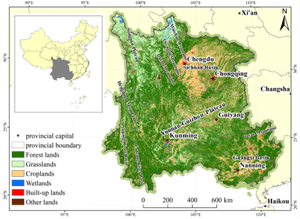
Figure Study area – southwestern China (left) and major county-level area types as defined by the spatial correlations between biodiversity, GEP, and economy in Southwestern China. H/L-H/L-H/L represents the High/Low relationship between biodiversity, GEP, and economy.
By Ziyan Lin, Tong Wu, Enming Rao, Yi Xiao, and Zhiyun Ouyang.
Understanding how to value nature’s contributions is a complex issue. The Gross Ecosystem Product (GEP) was introduced to give nature’s services an economic valuation. However, utilizing GEP alone isn’t enough for crafting precise strategies that reflect the unique natural and economic conditions of a region. Our study in Southwestern China innovatively applies GEP to bridge the gap between biodiversity conservation and economic development.
We explored how biodiversity, GEP, and economic factors are interlinked, identifying nine unique area types each showcasing different relationships among these indicators. Our findings challenge the usual assumptions, showing that areas rich in biodiversity don’t always have high GEP values, and regions with robust economies can maintain their biodiversity. Areas with robust ecological protection showed rich biodiversity but low GEP, whereas regions near major cities, benefiting from developed eco-tourism and agricultural production, demonstrated both high biodiversity and economic growth. Boosting all three indicators through their intersection primarily occurred in terms of GEP’s material (e.g., food production) and non-material (e.g., eco-tourism) components. We also looked into the natural and socio-economic features of nine distinct zones, discovering that areas excelling in biodiversity, GEP, and economy typically enjoy relatively better natural conditions (including moderate to high levels of temperature, precipitation, and relief) and face low population pressure.
We emphasize GEP’s importance in linking biodiversity conservation with economic growth, suggesting eco-friendly farming, forestry, and eco-tourism as beneficial strategies. This approach aims to harmonize environmental preservation with economic advancement, highlighting the critical role of informed, region-specific policies in achieving sustainable development.
 Relational Thinking