Photo credits: Li Li
By Huxuan Dai, Ziyun Zhu, Trachung Balzang, Golog Drugkyab, Mark Riley, Zhi Lü, and Li Li.
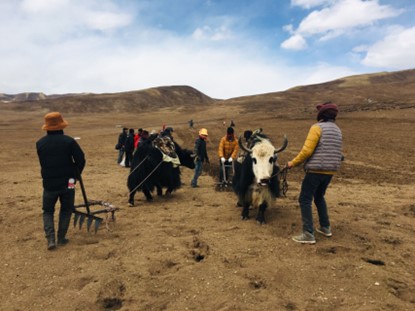
Local communities’ participation is crucial for ecosystem restoration initiatives. However, in situations where communities do not fully accept restoration techniques, how can things be improved? We explore this question on the Qinghai-Tibetan Plateau. Here, extremely degraded areas have lost their vegetation and root systems and can only be restored by grass replanting. Nevertheless, replanting was not an option for local pastoralists due to their worldviews and values associated with Tibetan Buddhism. The traditional way of adapting to degradation involves performing religious rituals such as praying. Grassland replanting, a newly introduced technique not previously practiced by pastoralists, remains ambiguous in its cultural implications. It is unclear whether replanting grassland is considered a Buddhist good deed or if it conflicts with the Buddhist doctrine, which advocates for avoiding disturbance to the land and harm to underground life.
In two communities with different levels of pastoralist engagement in grass replanting actions, Nyanze and Kouta, we explored people’s attitudes toward grassland restoration. We first conducted in-depth interviews with 36 key informants and obtained a concourse database when they talked about this topic. We then selected the 25 most distinguishable statements from the database and asked 57 pastoralists to rank the statements according to their degree of agreement or disagreement with each statement. By analysing the pattern of their rankings, we revealed eight types of pastoralists with different attitudes in two communities. Specifically, the pastoralist type of Active Agents created value-inclusive narratives of grassland restoration, integrating replanting with the local value system and leveraging transformative replanting actions in Nyanze. Noteworthy, many pastoralists within this group are found to be elites of the community.
We recommend that decision-makers recognize the significance of local worldviews and values in facilitating environmental adaptations, as well as the irreplaceable role that local individuals play in developing narratives that are inclusive of these values and align with the local cultural context. It is crucial to utilize policy instruments that enable and promote those narrative innovations. We also propose that the decision-makers initiate open dialogue among communities, restoration experts, and local government officials. Such dialogues would not only facilitate knowledge exchange but also enable the building of mutual trust and foster the accumulation and exchange of social capital, crucial for transformative actions in ecosystem restoration.
Our research explores the importance of understanding power dynamics in participatory process. Today, participatory processes are being advocated for in biodiversity conservation, with the assumption that having everyone around the table will suffice. However, as more people recognize that this may not be adequate due to varying power dynamics around the same table, there remains a lack of easily understandable propositions to analyze how power affects participatory processes. We propose a framework that deconstructs power, arguing that power is not just about control but also about the potential for positive change, exploring in which arenas people use power, how to they express power, in which space, and at what level.
Our research shows that when it comes to biodiversity, understanding power dynamics goes beyond just surface-level issues and disagreements among different groups of people, such as those concerned with wildlife. We found that the different ways power is expressed helps us see how people include nature and biodiversity in their goals. We also discovered that power operates at different levels, not just locally but also nationally and internationally, which is important in our interconnected world. Additionally, we identified two challenges in participatory processes for biodiversity: First, ensuring the voices of non-human beings are heard and, second, incorporating various knowledge systems into decision-making. Incorporating power into discussions about biodiversity means breaking down the usual conversations that only center on powerful people, their interests, and scientific knowledge. Instead, we need to develop new stories, knowledge, and ways of learning and acting that include a broader range of voices and perspectives.
 Relational Thinking