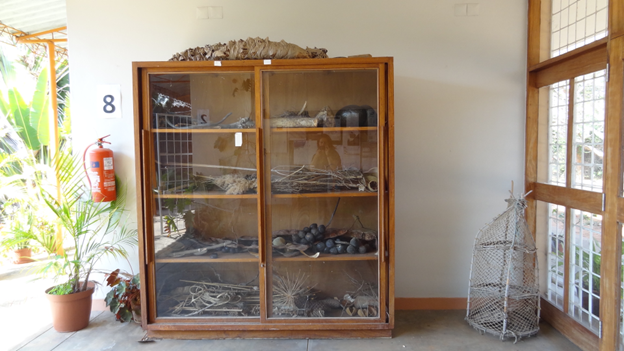
Photo credit: Tais Gonzalez Sonetti.
By María Mancilla García, Caroline Abunge, Salomão Olinda Bandeira, Christopher Cheupe, Dadivo José Combane, Tim Daw, Elizabeth Maria Drury O’Neill, Tilman Hertz, Marlino Mubai, Nyawira Muthiga, Taís Sonetti González, and Halimu Shauri.
In this paper, we explain how to use the traditional qualitative research methods of interviewing and coding in an innovative way: by considering them as tools to make sense of changing relations when studying perceptions of environmental change and practices where the social and the ecological are entangled. We conceive of these methods as opportunities to create encounters between the different elements in our research project, such as the researchers, the interviewees, their relations to their environment, the data on social-ecological practices, etc. This allows us to pay attention to elements frequently neglected when using these methods, such as the role of non-humans, of the physical space or of the researchers’ emotions in shaping the research process.
We evaluate our own use of these tools as part of a ‘process-relational’ project on perceptions of environmental change, that is, a project in which we focused on the role of relations between humans, but also between humans and non-humans and how these relations evolve to make sense of the daily experiences of people facing environmental changes in coastal communities of Kenya and Mozambique. This approach, with a focus on relations, is currently receiving a lot of attention from sustainability scientists, since many believe that it might provide insights into how social-ecological systems work and therefore help us craft more sustainable approaches to manage them. For this reason, it is crucial to develop methods that help us get those insights. Some of the aspects that our use of methods brings to light are similar to what other methodological perspectives have done. We show that the main difference is on the attention to physical and material aspects, i.e. the ecosystem, and on the strength of the links between researcher, researched, data and setting. We argue that traditional qualitative methods can be used to investigate the role of changing relations in social-ecological systems research. This is an important first step in methodological inquiry as it suggests that no method should be excluded from the outset when undertaking a process-relational study.
 Relational Thinking