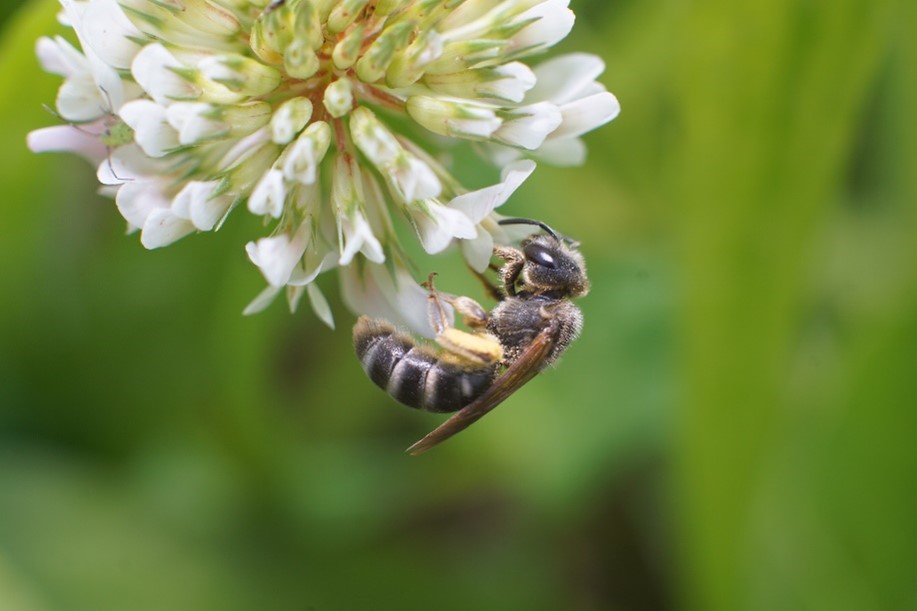
Photo credits: Giovanni Dal Zotto
By Costanza Geppert, Cristiano Franceschinis, Thijs P.M. Fijen, David Kleijn, Jeroen Scheper, Ingolf Steffan-Dewenter, Mara Thiene, and Lorenzo Marini.
Over the last few years, there has been growing interest in conserving insect pollinators. This interest is due to major concerns related to insect pollinator decline. However, a key piece of information to implement conservation actions is understanding what motivates people to participate in conservation activities. This key piece is still missing.
In our research, we wanted to uncover the reasons behind peoples’ desire, or lack thereof, to engage in pollinator conservation across three European countries (Germany, Italy, and the Netherlands). To do so, we interviewed 4541 citizens using an online questionnaire.
Our findings show that people intend to protect pollinators when they feel a moral obligation in response to a sense of joint responsibility and to the awareness of pollinator ecological importance. In addition, people are willing to protect pollinators when they receive support in their social environment and believe that their individual behaviour has an impact. People who frequently participate in nature-related outdoor activities, such as hiking, wildlife observation, or gardening, are particularly inclined to offer their support to pollinators. Surprisingly, potential engagement in conservation did not depend on nationality, age, education level, gender or living in urban or rural areas.
In all three countries, the conservation action that is most likely to be implemented is planting flowers rich in pollen and nectar, while one of the most unlikely is participating in monitoring schemes. While planting flowers refers to the widespread and beloved practice of gardening, participation in pollinator surveys requires the acquisition of a set of new skills and tools that make its implementation more difficult.
Several policy recommendations emerged from our study. Conservationists should prioritize raising awareness about the crucial role of pollinators and promoting experiences in nature that foster a sense of connection to and appreciation for these insects. These strategies show promise and can be applied across countries with contrasting socio-cultural and economic contexts.
 Relational Thinking