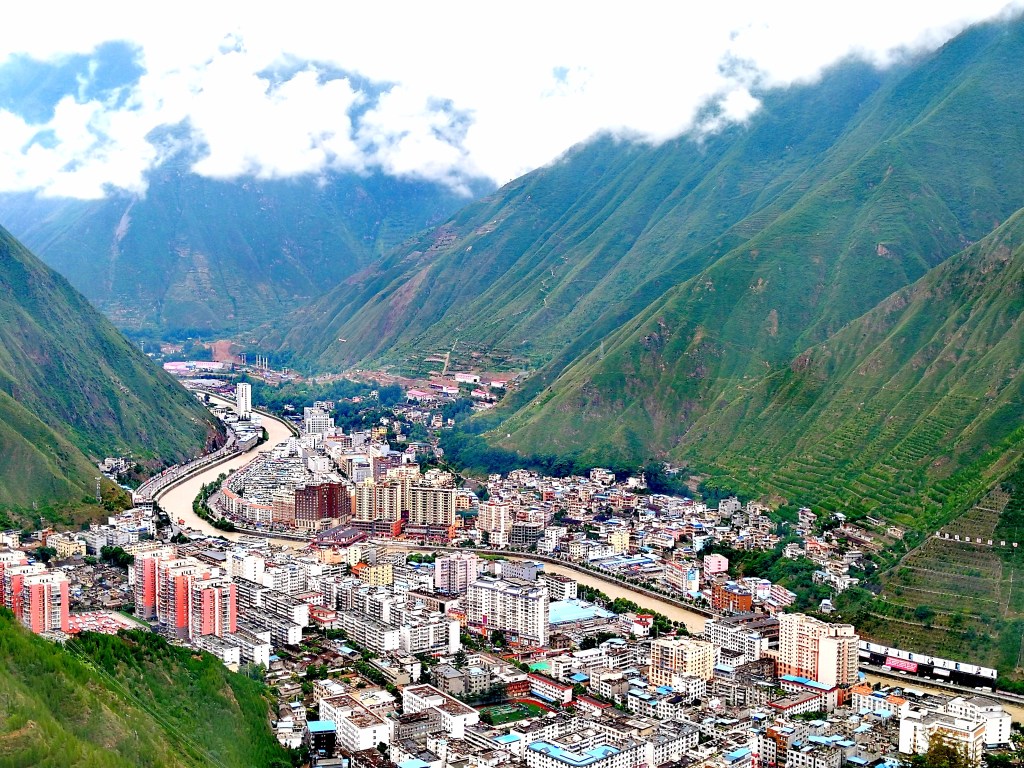
Photo credit: Baiping Zhang.
By Wenqi Xie, and Yonghui Yao.
Our human activities, whether in bustling cities or remote landscapes, leave a lasting imprint on the Earth. Have you ever wondered where and how deeply our human activities have left a mark on the environment? Nestled in central China, the Qinba Mountains became our research canvas to explore this by mapping the intensity of human activity map. The challenge? Existing global human footprint maps don’t quite capture the details. Importantly, there are limitations to the method of mapping HAI: an incomplete indicator system makes the assessment of HAI less accurate and comprehensive; ignoring redundant information among indicators, and subjectively combining all indicators led to potential overestimation of HAI.
So, we improve the approach. We designed an improved indicator system from two perspectives: natural environment and resources (including topography and river density) and social economics (population density, degree of land modification, remoteness from roads/railways, settlements, and road density). Each of these indicators was visually represented on maps to reflect the intensity of human impact from different perspectives. Subsequently, we applied the Principal Component Analysis method, transforming seven interconnected indicators into independent components to eliminate redundant information. Finally, by combining these independent components, we generated a high-precision map showcasing the varying intensity of human impact across QinBa.
And the findings? QinBa’s human impact is moderate overall. But places with low human impact were isolated as “islands” by places with high human impact, indicating that the scope of human activities in this area is extensive.
Why does making this map matter? Well, understanding how we impact QinBa helps decision-makers plan for sustainable development, conservationists protect vulnerable areas, and everyone grasps the delicate balance between human activities and the natural world. It’s a peek into the hidden connections between us and the environment we call home.
 Relational Thinking