By Paula Skye Tallman, Natalia C. Piland, Melanie Villarmarzo, Lulu Victoria-Lacy, and Armando Valdés-Velásquez.
In this perspective article, we suggest that the study of water insecurity and health among Indigenous peoples and local communities can be improved by applying a systematic analytic approach to the concept of waterscapes. The term waterscape describes the socio-natural relations between humans and water and is commonly used to draw attention to how power shapes the social, ecological, and political relations between humans and water. However, studies utilizing the concept of waterscapes generally lack a replicable analytic approach and do not explicitly feature the connectivity between water and human bodies, biology, and health.
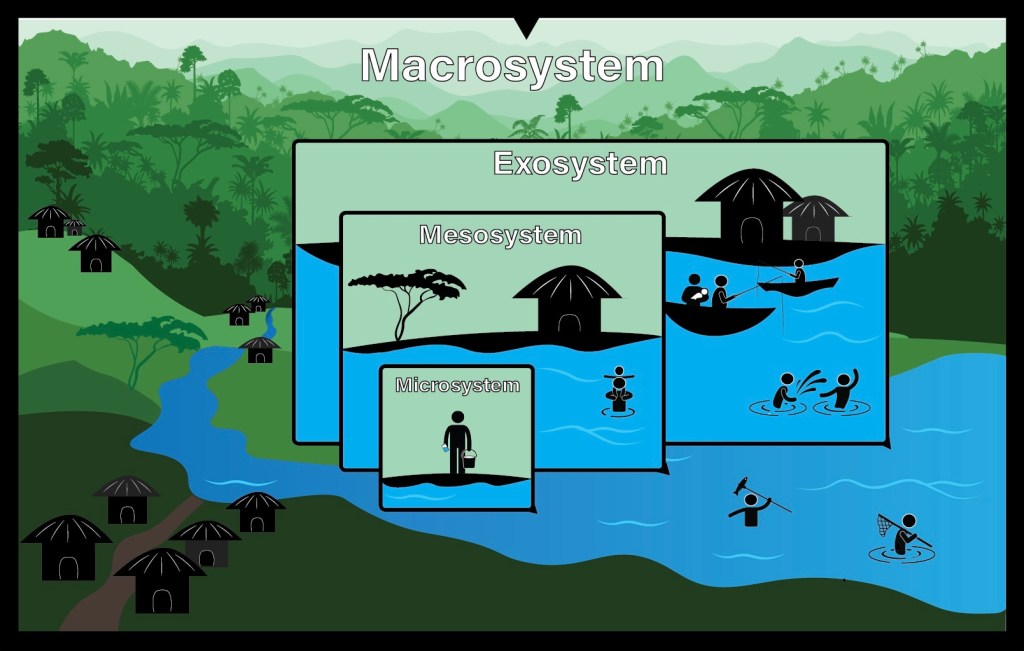
To make examining waterscapes more systematic, and to draw attention to human health, we use the four-tiered framework of the social-ecological model, which includes investigations on the individual (microsystem), household (mesosystem), community (exosystem), and spiritual (macrosystem) levels. We apply this four-tiered framework to describe the multi-level interactions between waterscapes and Indigenous peoples, with specific examples from the Amazonian watershed in South America. We then examine the case of the Belo Monte Dam in the Brazilian Amazon to chart how disruptions to the Xingu River waterscape produced water insecurity and related threats to the health and wellbeing of people living along this river. Our relational framework to examine water insecurity and health is generalizable to other populations whose livelihoods are closely connected to local waterscapes.
 Relational Thinking