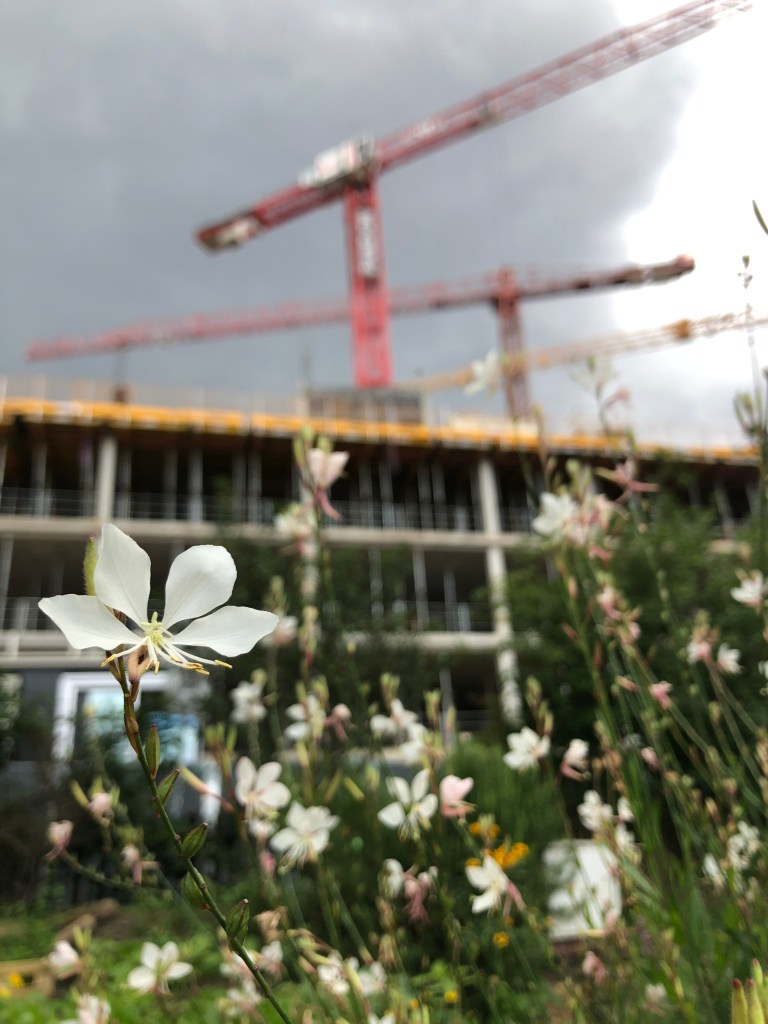
‘Bürgergarten Laskerwiese’ in Berlin, where building cranes dominate the skyline.
Photo: Monika Egerer
By Monika Egerer, Susan Karlebowski, Felix Conitz, Astrid E. Neumann, Julia M. Schmack, and Ulrike Sturm.
With the boom in urban living has come a boom in urban gardening. In particular, urban community gardening is an increasingly popular activity to build community. Community gardens are also where biodiversity can thrive, and gardeners can connect with and learn about nature. However, despite their benefits, community gardens face threats due to issues like uncertain land tenure and lack of policy protection.
In this perspective paper, we highlight the importance of recognizing community gardens as valuable ecosystems for urban conservation. We argue for city policies to formally support and protect these gardens based on scientific evidence from research conducted in Berlin and Munich, Germany. We have found that community gardens in these cities can contribute to biodiversity of plants and insects, and foster a strong connection between people and nature.
However, we raise a major concern that there is generally a lack of public data on the existence of community gardens, as well as the challenges that they may face, making them vulnerable to urban planning decisions. Indeed, we have seen losses of multiple community garden research sites in the last four years of biodiversity research.
To protect community gardens and the biodiversity within them now and for future urban residents, we call for systematic data collection on these gardening activities at the city level, along with policy support. We argue to acknowledge urban community gardens both in terms of physical land use and also as spaces managed by gardeners who play a crucial role in preserving urban biodiversity.
 Relational Thinking