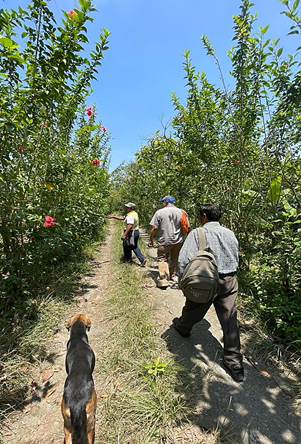
Photo by M. Satama-Bermeo.
By Maritza Satama-Bermeo, Max Rudolf, and Roland Olschewski.
Agricultural food production depends on natural conditions, such as climate, biodiversity and soil quality. At the same time, it can influence these conditions in a positive or negative way. Making all these impacts visible and measuring them is crucial to identifying ecologically and economically sustainable production systems. Similarly important is how farmers and consumers perceive and value these impacts, and what it would take to change their behavior towards a more sustainable food system.
To obtain this knowledge, we conducted a systematic literature review. We found two broad research strands: one strand is focussed on how to comprehensively assess the positive and negative impacts of agriculture, so-called services and disservices; the other strand looks at which impact such assessments might have on policy decision-making. Based on our findings, we recommend that future studies should adopt participatory approaches that go beyond monetary valuation techniques to account for the plurality of values involved, such as cultural identity, and local knowledge. Further, we argue that bridging the two research strands would be promising to provide more practice- and policy-relevant results.
Interestingly, of the studies we found, researchers conducted most of them in Europe and the United States. We conclude that more research on this topic is needed in the Global South. On the one hand, this will increase the awareness of agricultural services and disservices in these regions. Here, the focus should be on the farmers’ preferences and behavior in decision-making. On the other hand, conducting more studies in the Global South will encourage sustainable consumption patterns in the Global North, which imports and consumes the respective agricultural goods. Here the focus should be on the consumers’ preferences and behavior. In this way, future research could provide evidence for better-informed decisions of farmers, consumers, and politicians.
 Relational Thinking