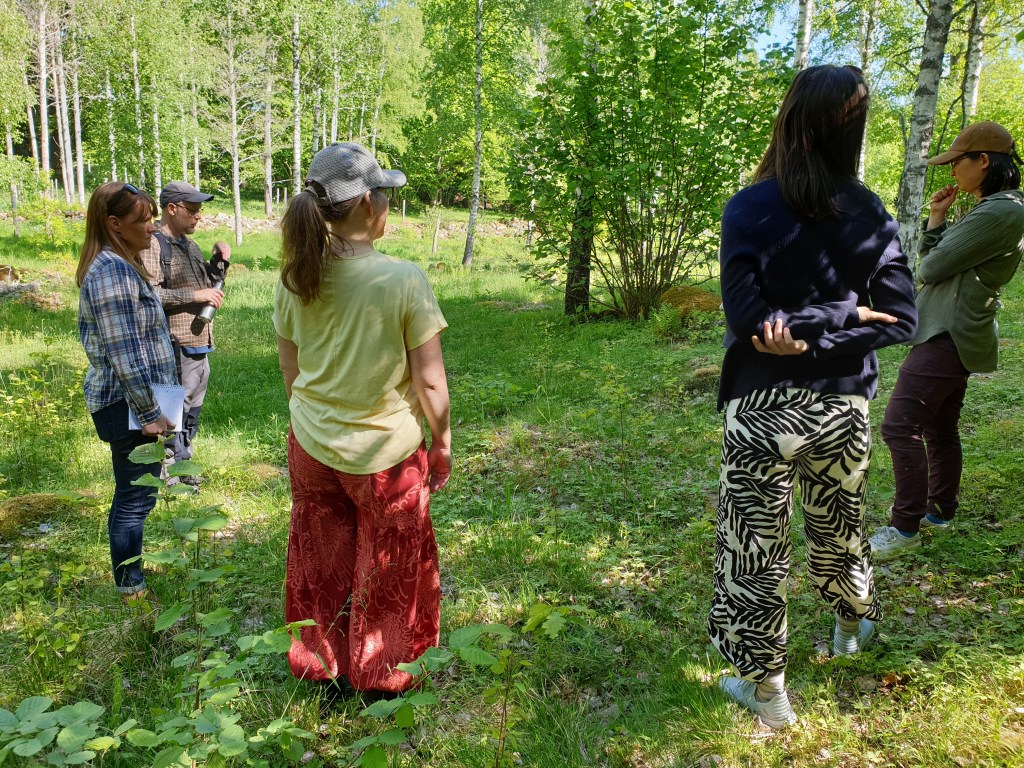
Photo: Hanna Fors.
By Hanna Fors, Anna Berlin, Uliana Gottlieb, Mari Kågström, James Weldon, and Jasmine Zhang.
This Plain Language summary is published in advance of the paper discussed; check back soon for a link to the full paper.
Our landscapes serve many important purposes, such as providing food, clean water, supporting biodiversity, and space for recreation. As the demand for these benefits, often referred to as ecosystem services and functions, continues to rise, it is more important than ever for researchers from different fields to collaborate. Together, they can develop strategies for managing land that can meet these different needs while minimising trade-offs (for example a forest may need to protect biodiversity, store carbon, provide timber, and be a space for recreation). A key problem is that these challenges are too broad for any single branch of research to tackle alone.
To guide researchers in this complex field, we made an analysis support tool, based in a set of key questions to foster thoughtful reflection and promote a sustainable approach. The process begins by defining the problem and envisioning solutions based on assessments of current landscape functions and their connections. Clarity and thinking about underlying assumptions, from desired achievements to the definition of functions and services, are essential. The needs of those who live in, work in and visit the area also have to be considered throughout the process. It’s also important to use appropriate methods to measure outcomes and evaluate the effectiveness of different approaches. Our focus on asking guided questions comes from recognising that there’s no one-size-fits-all solution for successful multifunctional landscapes. Instead, the aim is to identify suitable methods for specific circumstances and outcomes in a particular area. Multifunctionality is not an end in itself but a means to achieve broader objectives.
Multifunctional landscapes have the potential to address many ecological and social problems we face, now and in the future. However, achieving this requires a focused aim, a clear process, and input from researchers with diverse expertise. By adopting a holistic approach and considering the needs of all those who use a landscape, we can maximise the potential of multifunctional landscapes. This can lead to more sustainable and resilient land-use practices that benefit both people and the environment.
 Relational Thinking