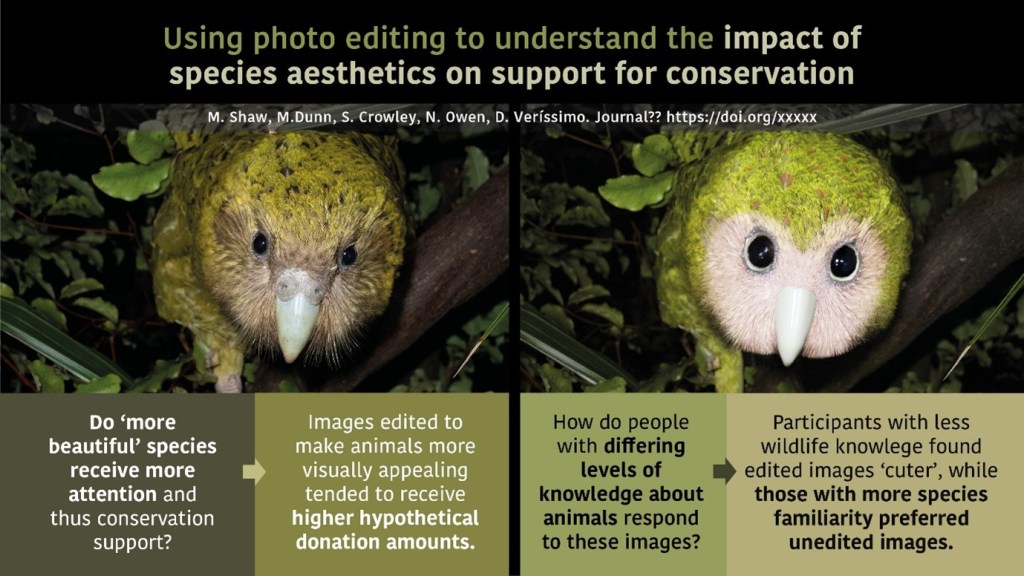
By Meghan Shaw, Matilda Dunn, Sarah Crowley, Nisha Owen, and Diogo Veríssimo
In the world of helping threatened animals, we’ve noticed a problem. Some animals that need our help don’t get as much attention and support as others. The animals that get the most help don’t necessarily need it most, they just look cuter or more interesting. We call this the “beauty bias.”
To gain a clearer understanding, we examined how enhancing the visual appeal of an animal’s image influences both the amount of monetary support people are willing to provide for the animal and their emotional response towards it. We asked a simple question: Do people give more money when they see a regular picture of an animal or when they see a picture that’s been made to look better? We did this by asking people to give hypothetical money to three animals in need of conservation attention: one that looked good, one that didn’t look good, and one with a fancier picture. What we found was interesting. People gave more money to the animals with the fancier pictures. This shows that people like helping animals that look good, even if it’s the same animal.
We also looked at how different people react to these different pictures. We talked to three groups: people who didn’t know much about the animals we were studying, people who knew about some of them, and experts in animal conservation. We found that people who didn’t know much about the animals thought the fancier pictures looked cuter, like cartoon characters. But people who knew more about animals and how to save them felt more connected to the regular pictures and thought the fancier ones looked strange, like something was not quite right. This tells us that what you know can change how you feel about these pictures and makes us think about whether we should change animal pictures.
In short, our findings show that good-looking animals get more help in conservation, and that’s not fair to the less good-looking ones. The findings also show that what you know about animals can change how you feel about their pictures and makes us wonder if it’s okay to change them. Understanding these things can help us make better choices when it comes to helping animals.
 Relational Thinking