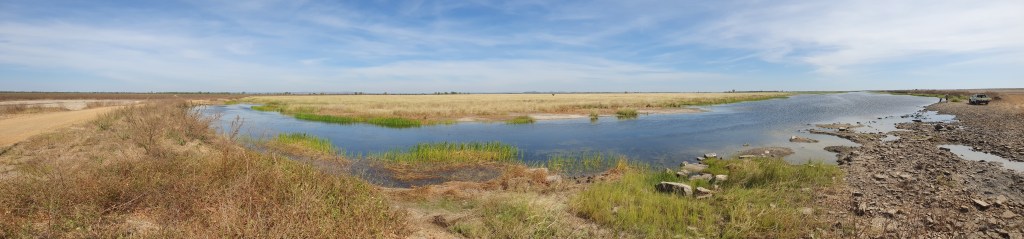
fostering a desirable coexistence through social change and action. The Legune coastal floodplain, of the
Northern Territory, Australia, has been home to Gadjerrong people for millennia, and is undergoing rapid
socio-ecological transformation that includes the spread of invasive plants. Cultivating coexistence here, as
elsewhere, means addressing issues of social justice, politics and power.
Photo credit: J. Atchison.
By Jennifer M. Atchison, Jenny Pickerill, Crystal Arnold, Leah M. Gibbs, Nicholas Gill, Ella Hubbard, Jamie Lorimer, and Matt Watson.
Biodiversity conservation efforts are grappling with questions about how humans can foster coexistence between the human and nonhuman world. The predominance of ecological approaches to such questions can overshadow that fostering a desirable coexistence requires understanding and working towards social action and change. In this paper, we use the idea of ‘peopled landscapes’ to explore questions about conservation, coexistence, and social action and change. Peopled landscapes is not a new idea. It is one that recognises the long and complex histories of human nature coexistence, and the dilemmas of conserving biodiversity at a time of environmental and social transformation.
We review scholarship and draw on case studies from Australia and the United Kingdom, to show how we can understanding two seemingly different environmental management processes—invasive plant management and rewilding—as interrelated processes of social action and change. We show that, while complex and contested, we can appreciate these processes through attention to agency, practices and capacity; how relationships between humans and nature are shaped, what actions are required of people; and whether and how people are empowered to act.
As social scientists, we argue peopled landscapes is an idea that can assist conservation to recognise and work towards the social changes that are necessary for all to flourish. To this end, conservation will need to recognise and engage with issues of social justice, the politics of environmental management and land-use decisions, historical and ongoing power relations between local and Indigenous peoples, and state governance. To do this, conservation can address: how actions acceptable to local and Indigenous people and those deemed responsible are shaped; what new or different practices are required, feasible and can be nurtured; and how collective capacities that accept diverse senses of responsibility and willingness to engage, are developed and sustained.
 Relational Thinking