By Katherine J. Kling, Timothy M. Eppley, A. Catherine Markham, Patricia C. Wright, Be Noel Razafindrapaoly, Rajaona Delox, Be Jean Rodolph Rasolofoniaina, Jeanne Mathilde Randriamanetsy, Pascal Elison, McAntonin Andriamahaihavana, Dean Gibson, Delaïd Claudin Rasamisoa, Josia Razafindramanana, Natalie Vasey, Carter W. Daniels, and Cortni Borgerson.
Natural resources play an important role in the lives of people around the world. They provide timber and fuelwood, ethnopharmaceuticals, and food, among many other products. Natural resources can be especially important in the lives of the rural poor. Often, however, wild resource extraction is an unsustainable practice that some frame as running counter to many conservation aims. But is this necessarily so? For both people and wildlife, understanding whether wild resource extraction is harmful to conservation goals is crucial for developing informed, actionable management recommendations that support the requirements of all natural resource users.
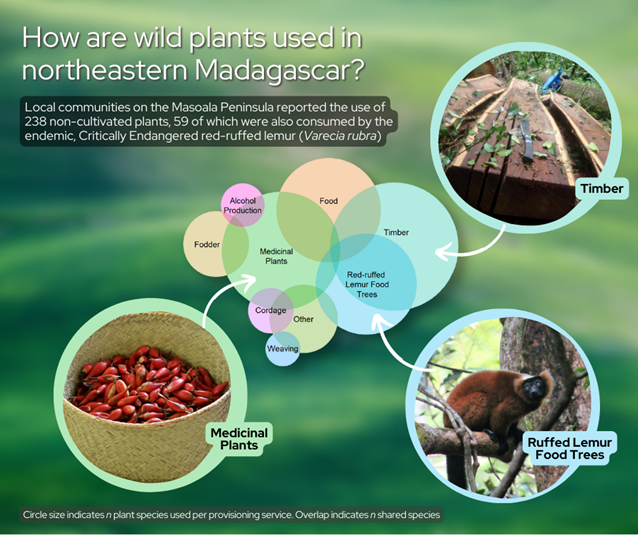
We sought to understand how wild plants are used on the Masoala Peninsula, a global biodiversity hotspot in northeastern Madagascar. There, extensive landscape conversion threatens the availability of non-cultivated plants at a broad scale, but the impact of natural resource use at the local scale is unknown. Using community focus groups and botanical plots, we evaluated the impact of four known proxies of human resource use – distance to settlements, community population size, use over time, and spatial management policies (i.e., protected area status) – on the availability of resources local people use for timber and as medicinal plants. We also examined the impact of wild plant use on the availability of food resources for the Critically Endangered red-ruffed lemur (Varecia rubra).
We documented the local use of over 200 types of wild plants, one-quarter of which red-ruffed lemurs also consume. People could reportedly harvest one hundred tree species as timber and identified 72 plants as medicine. Plant resources declined with nearly all of the measures of human pressure we tested. Resource availability decreased with community population size, declined over time (2015-2021), and was lower among communities than within the protected boundaries of Masoala National Park.
Our results indicate a genuine conflict between the resource needs of endemic wildlife and local communities, in that humans and red-ruffed lemurs use the same plants. However, our work also reveals opportunities for mitigating this conflict, for example, by highlighting alternative timber species that people could harvest. Research efforts that seek to understand plant uses from a local perspective are critical for generating landscape restoration and wild plant management strategies that can support sustainable resource use.
 Relational Thinking