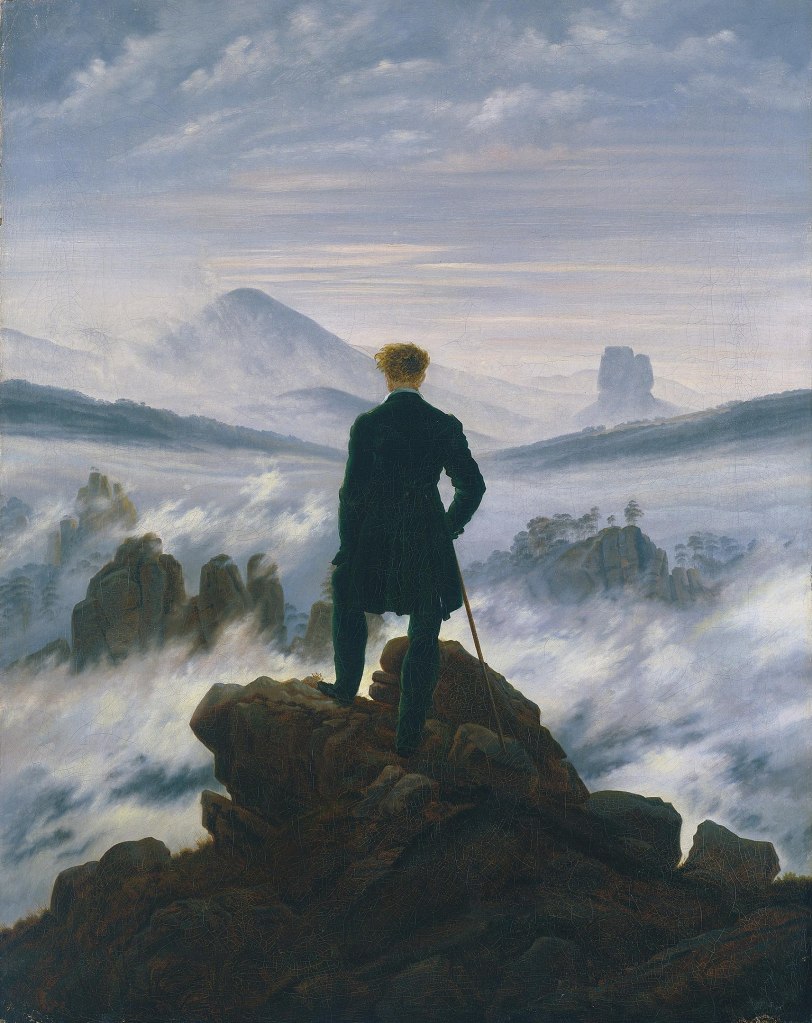
Wanderer above the Sea of Fog, circa 1818.
Copyright: Hamburger Kunsthalle / bpk. Image credit: Elke Walford
By Erik Aschenbrand.
An ever-increasing share of the global population lives in cities while an ever-decreasing share works in agriculture. These interrelated and enduring trends contribute to a loss of opportunities to experience nature. As with the extinction of species, this phenomenon is pointedly referred to as the ‘extinction of experience’.
During the urbanization process, people are shifting their economic activities toward jobs characterized by less direct interaction with nature. Opportunities for nature experiences are not only reduced, but changing structurally because physical outdoor activities and nature experience take on a new meaning as recreational activities. For example, the nature experience of a recreational angler differs from that of a traditional fisherman, even when the practices are very similar. To understand the consequences of these structural changes, I introduce a new typology that defines experiences of nature by considering their social context: economic and recreational. With urbanization, the proportion of nature experiences that take place in leisure time (recreational experience) is increasing relative to that which takes place in a work and production context (economic experience).
Compared to economic experiences of nature, recreational experiences often require less skill and knowledge while relying on stereotypical ideas about nature, demonstrated, for example, by traditional land uses and tourism, respectively. With urbanization, the proportion of recreational nature experiences will continue to increase, raising an important question: How can the recreational relation to nature contribute to long-term engagement and responsible stewardship?
Long-term engagement is evident in leisurely behavior where people pursue hobbies. In urban societies, many people invest a considerable amount of time and material resources into their hobbies, while developing specific skillsets and acquiring extensive knowledge in the process. Furthermore, nature-related hobbies enable the transformation of irrelevant economic experiences into meaningful recreational experiences, allowing the emergence of an individual perspective on and a lasting relationship with nature. Protected areas and other organizations curating nature experiences can create and promote experiences that relate to nature-based hobbies while supporting skill development.
 Relational Thinking