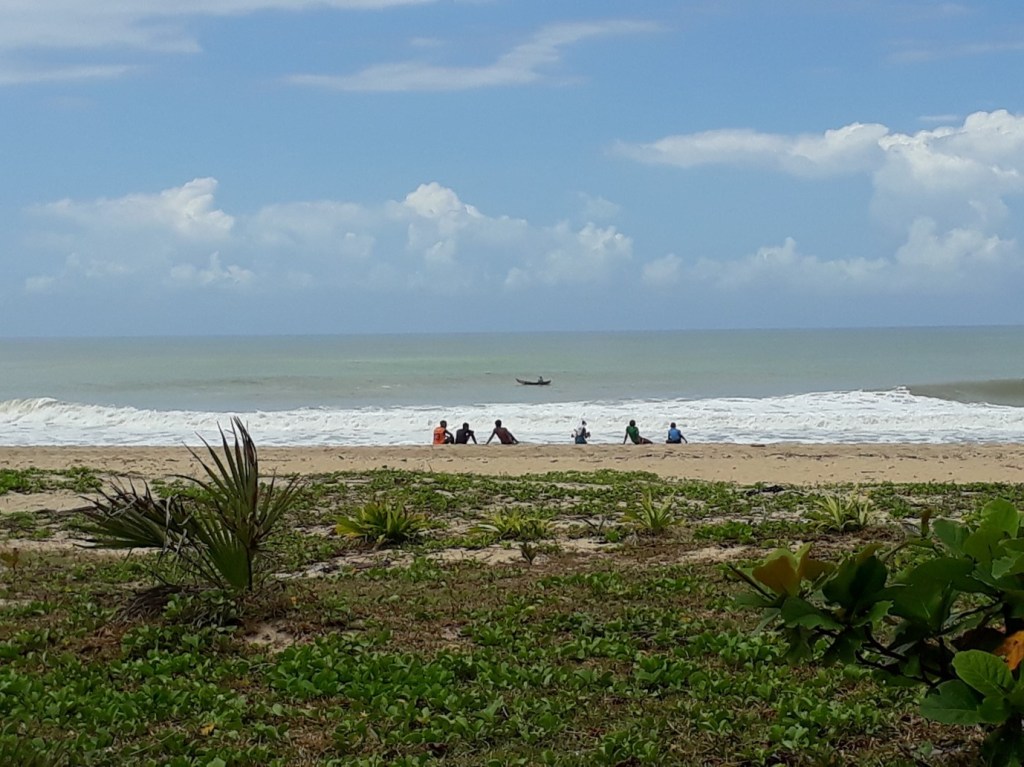
Photo credit: Jan Petzold.
By Jan Petzold, Aleksandra Kosanic, Felana Rakoto Joseph, Princy Rajaonarivelo Andrianina, Sitraka Mireille Ranaivosoa-Toandro, Onintsoa Ravaka Andriamihaja, Leonnie Marcelline Voahanginirina, Lara Thien and Mialy Razanajatovo.
Recent climate change is impacting our ecosystems and the availability of their services. Marginalised and vulnerable communities in the Global South are at particular risk. In this research, we look at local communities’ perceptions of climate change impacts on Nature and their livelihoods (for which we use the so-called Nature’s Contributions to People (NCP) framework). We were interested in seeing how these changes affect the wellbeing of rural communities in four sites in Madagascar. Our study sites were in Central (Ambohimalaza and Mantasoa) and Eastern (Andovoranto and Andasibe) Madagascar.
To investigate this topic, we used a combination of different methods. We conducted participatory community workshops, mapping and semi-structured interviews with local communities and across different social groups. We found out that Nature’s material benefits, such as food, water, and wood, are more often linked to wellbeing, although non-material benefits, such as spiritual practices, peace of mind, and recreational activities (for example, swimming), play an important role as well.
Nature’s material and non-material benefits are affected by climate change through rising sea levels, coastal erosion, biodiversity loss, droughts, rainfall and temperature variability. In some cases of drastic changes, people expressed what we call ‘ecological grief’. Examples of ecological grief are sadness that can appear after the loss of land and forests or the loss of part of their cultural identity due to forced changes in lifestyle. We also identified intergenerational concerns about fairness and responsibility regarding climate and environmental change.
Overall, our findings show that climate change and related ecosystem degradation have tangible and visible impacts on Nature’s Contribution to People and the wellbeing of local communities. We recommend that future research focuses on multiple values of Nature to deepen the understanding of our connection with Nature for our wellbeing. A focus should also be placed on intersectionality –looking specifically at interlinked aspects of gender, ethnicity, disability, etc. – within local communities to support a better quality of life and pro-environmental behaviour, leading to more equitable conservation strategies to achieve sustainable and just futures.
 Relational Thinking