By Christina Choy, Hollie Booth, and Diogo Veríssimo.
Sharks and rays are highly threatened. The primary threat is overfishing due to targeted and unintentional catches. Notably, the demand for shark fin soup, a popular delicacy among Asian communities worldwide, creates a high market price for the fins of certain shark and ray species. Yet, understanding of consumer behaviour rarely informs conservation policies and interventions for sharks.
Singapore is a global entrepot for shark fin trade, where critically endangered species are regularly sold and consumed. As such, consumer-focused interventions in Singapore are a necessary component of a more sustainable future for shark populations. Furthermore, Singapore is a leading market for lab-cultured proteins, which offer opportunities as substitutes for wild-sourced shark fins. However little is understood about consumer behaviour and preferences regarding consumption of real and alternative shark fins.
To address these gaps, we presented 300 shark fin consumers in Singapore with a plausible purchasing scenario, in which they had to choose one of four alternative shark fin soup options. These options had different combinations of soup attributes (price, fin size, fin texture, source of fins and type of menu (e.g. a la carte vs. set menu). Over a total of 15 rounds with different combinations of attributes, we asked consumers to select which shark fin soup they would most like to purchase. Based on their selections, we can infer consumers’ preferences for different attributes. We also obtained data on their demographic characteristics, purchasing and consumption patterns, and level of environmental concern (Figure 1).
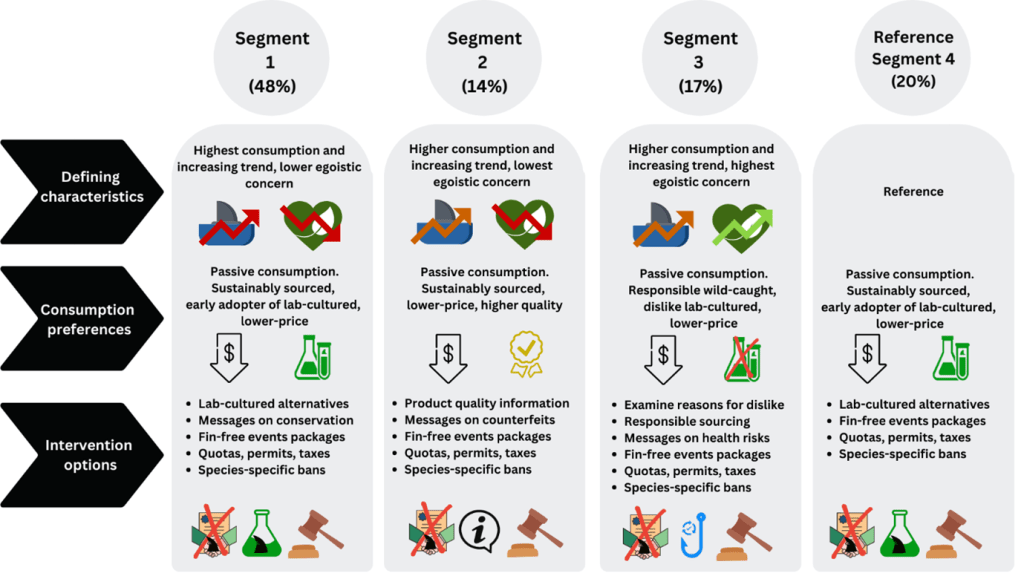
We found that all respondents exhibited preferences for more responsibly-sourced and lab-cultured shark fins. As expected, price was also a significant factor, which influenced consumer choices between potentially substitutable products. We also identified four consumer segments, each with slight differences in their demographics and consumption behaviors. Segment 1 is the largest and comprises almost half of the sample population who preferred sustainably sourced and lower-priced fins. Segment 2 is alike but stood out for preferring higher quality fins. Segment 3 also comprised members who favored shark fins from responsible fisheries, but disliked lab-cultured shark fins. Importantly, a great deal of consumption appears to be passive (i.e. at wedding or special events wherein shark fin is provided for guests) rather than diners asking specifically for shark fin.
Our research provides much-needed evidence for three types of consumer-focused interventions that could alleviate shark fishing pressure: (i) market-based interventions relating to sustainable fisheries and substitute lab-cultured products; (ii) government-led policy-level interventions on the sale and trade of shark products; and (iii) targeted demand-reduction efforts for different consumer segments and contexts to ensure market demand remains within the limits of sustainable supply.
Drawing on a complementary mix of these strategies could help to reach the largest number of consumers and create positive, rippling impacts on global shark and ray populations and coastal communities.
 Relational Thinking