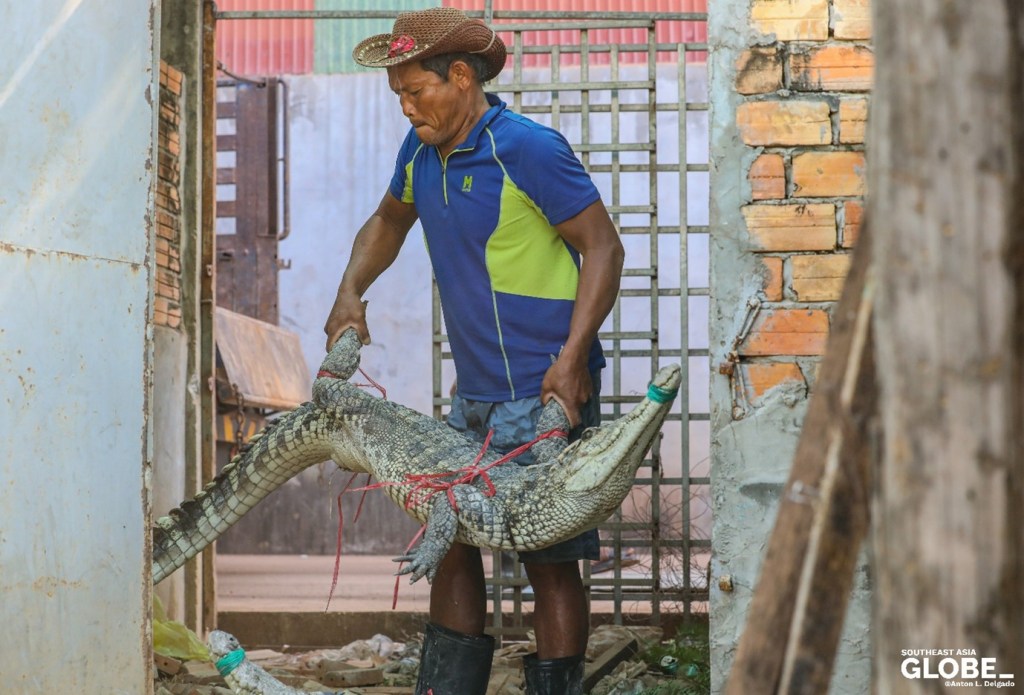
(Image: Anton L Delgado/Southeast Asia Globe)
By Dominic Meeks, Oscar Morton, and David P. Edwards.
The global wildlife trade supplies a growing demand for animal and plant commodities for clothes, decorations, pets, food, and traditional medicines. Overexploitation has contributed to declines among many desired species, prompting the development of alternative strategies to supply global demand. One such strategy is wildlife farming – the rearing and breeding of wild animals in captivity. Over the last 20 years, wildlife farming has grown in scale, with thousands of captive-bred specimens traded annually, including well-known species, including the tiger, Asian black bear, and American alligator. Wildlife farming has the potential to deliver sustainable livelihoods to rural communities and reduce harvesting pressure on threatened wild populations. Our review evaluates the extent to which wildlife farming is delivering positive outcomes for people and nature.
We find evidence for widespread illegal wildlife trade in wildlife farming. Individuals of valuable threatened species are regularly extracted from the wild and labelled as captive-bred in international trade to avoid stricter regulation, in a process known as laundering. It is also cheaper for small-scale farmers to establish and maintain captive populations by taking unregulated quantities of specimens from wild populations. Wildlife farming of reptiles to supply leather products provided sustainable incomes and a supplementary food source to local communities without compromising wild populations. There is also growing evidence that consumers are willing to substitute wild-sourced products for captive-bred products.
To resolve the aforementioned issues, we determine that policy must be reformed to reflect the complexity of wildlife farming. Potential cases of laundering, especially those involving threatened species, must be scrutinised. Conversely, wildlife farming involving suitable species that delivers sustainable incomes to rural communities must receive additional support. We provide a decision framework, incorporating the diversity of factors that influence the outcomes of wildlife farming to aid governments and regulatory authorities in this decision process. Wildlife farming will remain a feature of global wildlife trade; whether it remains a source of additional pressure to wild populations or provides conservation and economic value will be determined by the ability of management strategies to restrict fraudulent trade and promote legitimate participation among local communities.
 Relational Thinking