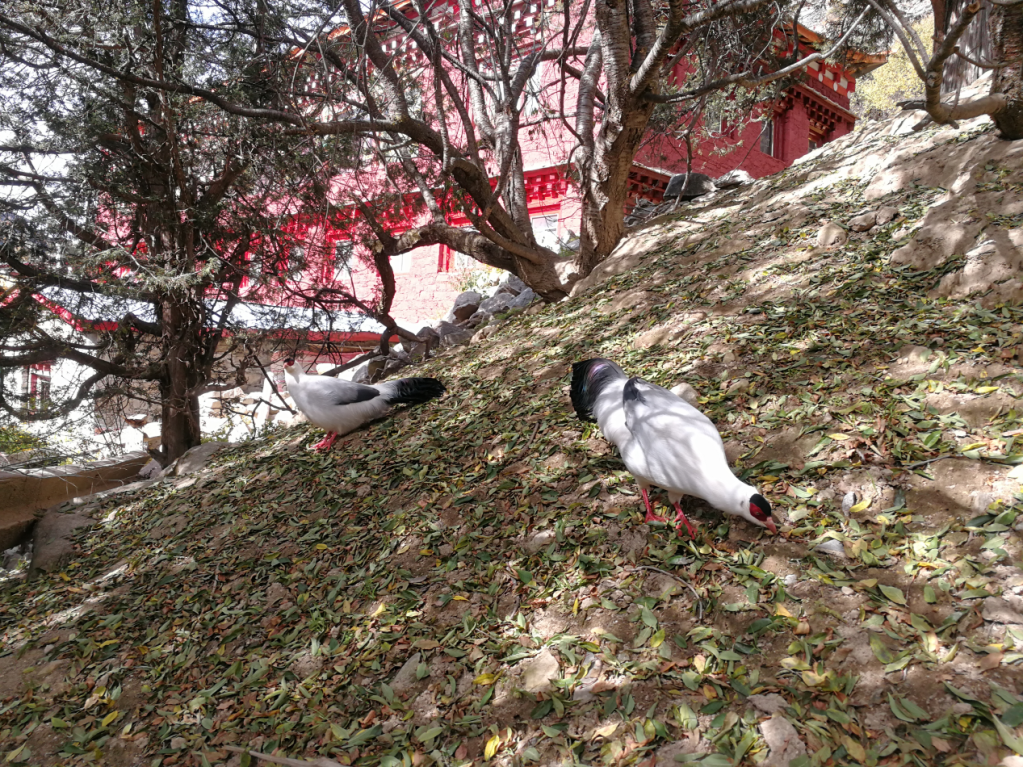
Photo credit: Yuehua Sun
By Gesang Wangjie, Yingqiang Lou, Kai Song, Xinhai Li, Yun Fang, Jianhua Hou, and Yuehua Sun.
As the extent and intensity of human activity increases, the conflicts between humans and wildlife also intensify. While the concept of human and wildlife coexistence was proposed and developed over the past 30 years, there are some cases of long-term coexistence between indigenous people and wildlife in many parts of the world. Influenced by the Tibetan Buddhist culture of not killing, killing less, and treating various life forms, indigenous people used monasteries as a platform for the coexistence of various forms, including monasteries protecting land, monks and believers feeding wild animals, and celestial burials (leaving a corps at a high elevation, such as on a mountaintop). The large number and wide distribution of Tibetan Buddhist temples on the Qinghai-Tibet Plateau indicate that they may play an important ecological role. For instance, we collected extensive photographic evidence of a possibly higher density of birds around the monasteries.
Thus, to investigate the relationship between Tibetan Buddhist monasteries and their nearby birds, we collected a total of 262 bird-watching reports from 39 regions of the Qinghai-Tibet Plateau. We developed mathematical models to test whether the presence of the monastery affects the abundance and diversity of the surrounding bird populations. To improve the reliability of our analysis, we considered several factors that may influence the distribution of birds. The results showed a significant positive correlation between the presence of monasteries and nearby birds, although no such correlation was observed for bird diversity. The greater number of birds around the monastery are mainly scavenging raptors and passerine birds. The presence of celestial burials is an important factor leading to increasing the number of carrion-eating birds, such as Black Kites (Milvus migrans) and Himalayan Griffons (Gyps hinalayensis).
Our study establishes a clear link between Tibetan Buddhist monasteries and the abundance of surrounding bird populations. Although we did not find a direct correlation between the monastery and bird diversity, it is still undeniable the potential conservation value of the monastery for bird populations. Especially in the eastern part of the Qinghai-Tibet Plateau, with rapid urbanization, it is crucial for the government and the scientific community to fully understand the ecological significance of Tibetan monasteries, further explore their ecological functions, and realize the ecological protection not limited to the protected areas.
 Relational Thinking