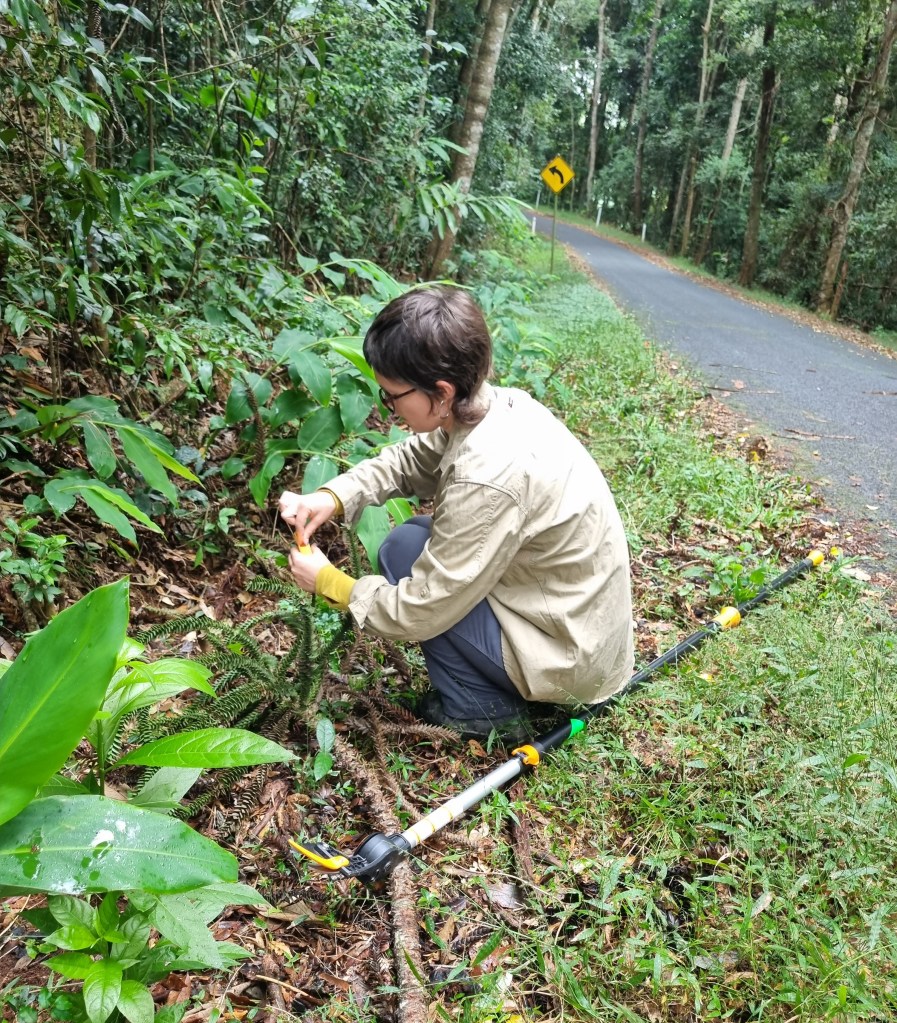
Bunya leaf tissue for DNA extraction and genotyping at Maleny on Kabi Kabi country, southeast Queensland,
Australia.
Photo credit: Em Ens, 2022 and with consent of Monica.
By Monica Fahey, Maurizio Rossetto, Emilie Ens, and Ray Kerkhove.
There is growing interest in understanding how Indigenous Peoples in Australia impacted and managed plants over the last 12,000 years. In particular, there is a desire to ‘re-discover’ Indigenous ecological knowledge that has been disrupted by European colonization. Bunya Pine (Araucaria bidwillii) is a culturally and spiritually significant conifer tree for several Indigenous groups in eastern Australia. Sharing the edible nuts and attending ‘Bunya gatherings’ is an important way for these groups to maintain kinship and cultural connections, often transporting the nuts long distances. Bunya grows in Southeast Queensland (SEQ) and over 1,400 km to the north in the Australian Wet Tropics (AWT). Scholars have hypothesized that prior to European colonization, Indigenous Peoples facilitated the dispersal of Bunya through these ancient traditions. However, it is unclear whether Indigenous groups widely moved plants.
In this study, we took Bunya leaf DNA samples to reconstruct the shared ancestry between trees within and between the two regions and to infer the historical movement of Bunya across the landscape. To interpret genetic data, we used historical sources and cultural information about Indigenous Peoples’s use of Bunya. We identified genetic patterns that suggest a long-term absence of Bunya dispersal within AWT, where Indigenous knowledge of its use is limited and extensive dispersal amongst sites in SEQ, consistent with historical and cultural evidence of human transport of the plant. However, we found less connectivity amongst sites known to pre-date European colonization, than when colonial-era planted sites were included in our analyses. Additionally, our demographic models based on population genetic theory did not indicate rapid population growth that could support significant human promotion of Bunya. These findings suggest that the pre-colonial movement was sporadic or localized rather than systematic and widespread. We concluded that pre-colonial movement of SEQ Bunya Pine was likely restricted by kinship-based custodial rights, and that when European settlers displaced Indigenous Peoples, Indigenous people more significantly moved Bunya to maintain cultural connectivity.
This study is an example of how Indigenous Australian groups adapt their plant management strategies to meet socio-cultural needs and demonstrates the potential for plant genomics to supplement Indigenous knowledge impacted by colonial dispossession.
 Relational Thinking