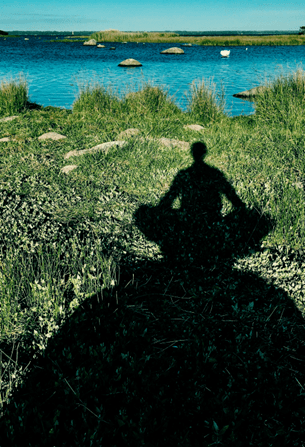
Photo: Jonathan Stoltz
By Jonathan Stoltz, Carl Lehto, and Marcus Hedblom.
Researchers have established that being outdoors can have positive effects on our health. However, there are questions about what specific characteristics of outdoor places are most important for meeting people’s needs and preferences. There are eight qualities people typically look for in outdoor environments: Natural, Cultural, Cohesive, Diverse, Sheltered, Open, Serene, and Social aspects. Each is important for assessing and planning green spaces in ways that promote public health and well-being. However, it is not clear how strongly these qualities are linked to the actual features of the outdoor spaces.
To investigate this, we conducted a survey in Sweden where we asked people to mark their favourite outdoor places on a map and rate how much each of these perceived qualities was present in those places. We found that the qualities most commonly reported as present in these favourite places were Open, Serene, and Sheltered, while Social and Cultural qualities were less common. Further analysis showed that people’s favourite places could be grouped into two main categories based on the qualities they emphasized. One group focused on qualities like Natural and Serene, which are associated with a more restorative experience. The other group highlighted qualities like Social and Cultural, suggesting a more outward-directed experience.
Surprisingly, when we used machine learning models to examine the relationship between the objective characteristics of the outdoor spaces and the perceived qualities, we found weak connections. Instead, the perceived qualities were more strongly linked to personal characteristics, such as how much a person identified with urban or nature-oriented preferences. That important perceived qualities of the outdoors cannot be universally mapped or modelled presents a challenge for planners and other decisionmakers. It suggests that objective landscape measures and individual user characteristics always need to be considered together when planning landscapes in support of people’s recreational needs, indicating a need for dialogue and engagement with local users as a complement to structural analyses.
 Relational Thinking