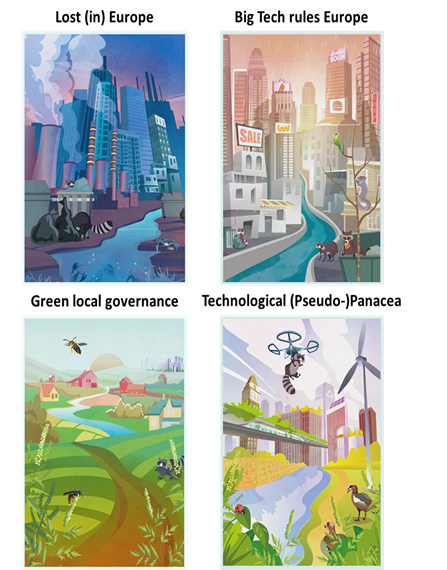
Illustrations by K. Tsenova.
By Cristian Pérez-Granados, Bernd Lenzner, Marina Golivets, Wolf-Christian Saul, Jonathan M. Jeschke, Franz Essl, Garry D. Peterson, Lucas Rutting, Guillaume Latombe, Tim Adriaens, David C. Aldridge, Sven Bacher, Rubén Bernardo-Madrid, Lluís Brotons, François Díaz, Belinda Gallardo, Piero Genovesi, Pablo González-Moreno, Ingolf Kühn, Petra Kutleša, Brian Leung, Chunlong Liu, Konrad Pagitz, Teresa Pastor, Aníbal Pauchard, Wolfgang Rabitsch, Peter Robertson, Helen E. Roy, Hanno Seebens, Wojciech Solarz, Uwe Starfinger, Rob Tanner, Montserrat Vilà, and Núria Roura-Pascual.
Biological invasions—that is, the introduction, establishment and spread of species beyond their native range—are a major threat to global biodiversity, ecosystem functioning and human well-being. Biological invasions have increased over the past centuries, with a marked increase in recent decades. This recent increase is alongside the acceleration of other anthropogenic global change drivers. Under future projections, if historic trends remain the same (if we continue with business-as-usual), the number of non-native invasive species is projected to increase by over 30% compared to 2005. However, understanding how biological invasions might change under different plausible futures requires us to explore alternatives beyond business-as-usual. We need to explore additional policy options and management strategies.
In this study, we developed four plausible scenarios of biological invasions in Europe until 2050. We call these the European Alien Species Narratives (Eur-ASNs). We compared the Eur-ASNs with their global counterparts (the Global-ASNs) and scenarios developed for climate change and biodiversity projections (the Global and European Shared Socioeconomic Pathways or SSPs). We found a high overall consistency between Global and European scenarios of invasions, with variations attributable to differences in spatial scale and context. For example, while biological invasions are projected to increase with rising global population density in the near future, they might decrease at the European scale. We also found substantial divergences among the different scenarios, with larger differences between the ASNs and SSPs than within scenario initiatives across different scales (global vs. European).
These findings underline the importance of considering independent and complementary scenarios of biodiversity change to capture the complexity of biological invasions and the need to consider such new scenarios when projecting future biodiversity dynamics.
 Relational Thinking