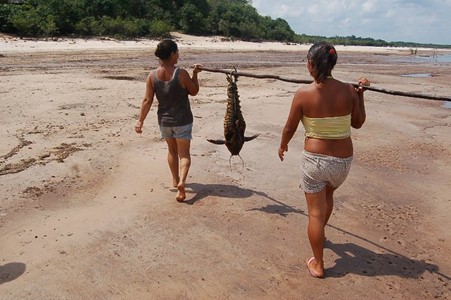
Photo Credit: Rachel Carmenta.
By Carmenta, R., Zaehringer, J. G., Balvanera, P ., Betley, E., Dawson, N. M., Estrada-Carmona, N., Forster, J., Hoelle, J., LLiso, B., LLopis, J. C., Menon, A., Moeliono, M., Mustin, K., Pascual, U., Rai, N., Schleicher, J., Shelton, C., Sigouin, A., D., Sterling, E. J., Steward, A. M., Tauro, A., White, C., Woodhouse, E., and Yuliani, L.
Across the world our landscapes are changing, and as a consequence so are our relationships with them. One of the places where landscape change is most pronounced is the tropics. In tropical regions, the cause of change is often the distant demand for the commodities that are produced in these regions. Yet, the interventions to stop change usually target the local level. This creates a situation in which both changing landscapes and the interventions to stop that change impact Indigenous People and local communities living in places of high biological, cultural and value diversity. We need to know more about the full range of impacts this situation creates if we are to achieve a just and fair understanding of what landscape change means, and the impact that interventions have on these communities.
One way that we can understand better the full impacts of these processes is to better capture the non-material values that people hold for the places they inhabit. This includes relational values – for instance, the identities people derive from place, and the relationships that are only possible through interaction with place. Further, these relational values also contribute to human wellbeing in often ‘invisible’ ways. Expanding the current tendency to address and measure the material values of nature, and the material dimensions of peoples’ lives and livelihoods is essential to fully appreciating the implications of landscape change, and associated conservation and development intervention. This paper outlines key difficulties associated with doing so, and action-points for how to overcome them. It also gives an overview of some of the methods available for better accounting for the plural values of nature in order to advance conservation and development research and practice. The paper itself is a Synthesis of a Special Feature: What is lost in transition? Capturing the impacts of conservation and development interventions on relational values and human wellbeing in the tropics, and was made possible after workshops using Open Forum method with all contributing authors.
 Relational Thinking