A blog post by Erle Ellis, Associate Editor for People and Nature, regarding the recent article ‘Past human-induced ecological legacies as a driver of modern Amazonian resilience’.
Read the full paper discussed here in our Open Access journal.
Read the Plain Language Summary for this paper at Relational Thinking.
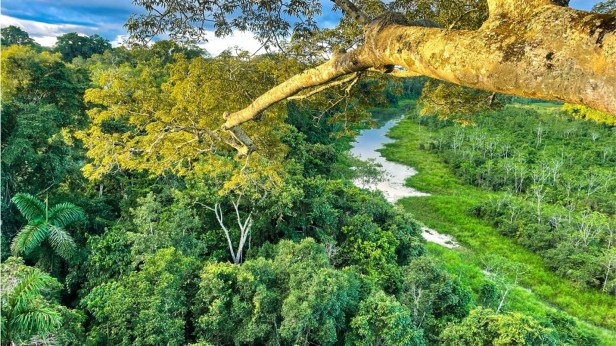
Two obsolete paradigms continue to haunt ecology and conservation. The first is that large areas of forest, including most of Amazonia, were uninhabited and unused by people until recent centuries – the myth of pristine wilderness (Fletcher et al. 2021). The second is that all human use of forests and other ecosystems is inherently harmful (Bliege Bird and Nimmo 2018, Lombardo et al. 2020, Malhi et al. 2022).
In their new paper, McMichael et al. (2023) take us beyond the myths by introducing a fresh approach to understanding and investigating the deep cultural legacies of sustained human use in Amazonian forests. Their framework and methodology has profound implications for forest conservation and management well beyond Amazonia. This is the kind of paradigm-shifting paper that should be read by everyone involved in forest ecology, conservation, and management.
McMichael et al. (2023) build on evidence that past use of Amazonian forests by Indigenous peoples through practices including cultural burning, cultivation, and propagation of domesticates and other favored species increased their resilience to disturbance centuries later by reshaping the distribution of forest functional traits, soils, and other ecological legacies. The evidence they present is strong and connected directly with major implications for contemporary forest conservation and management. But McMichael et al. (2023) go much further, offering a cornucopia of methodologies for assessing and mapping cultural legacies in forests from palaeoecology to archaeology to remote sensing by satellites and unmanned aerial systems (UAS).
Early career ecologists should seize this opportunity with both hands. There is so much critical work to be done uncovering and understanding the cultural legacies of early land use and their shaping of terrestrial ecology and biodiversity as we know it across the planet – well beyond Amazonia and well beyond forests (Ellis 2021). As McMichael et al. (2023) show, these cultural legacies have powerful implications for ecology and biodiversity today, and the tools are there to reveal them to the world.
References:
Bliege Bird, R., and D. Nimmo. 2018. Restore the lost ecological functions of people. Nature Ecology & Evolution 2:1050-1052.
Ellis, E. C. 2021. Land Use and Ecological Change: A 12,000-Year History. Annual Review Of Environment And Resources 46:1-33.
Fletcher, M.-S., R. Hamilton, W. Dressler, and L. Palmer. 2021. Indigenous knowledge and the shackles of wilderness. Proceedings of the National Academy of Sciences 118:e2022218118.
Lombardo, U., J. Iriarte, L. Hilbert, J. Ruiz-Pérez, J. M. Capriles, and H. Veit. 2020. Early Holocene crop cultivation and landscape modification in Amazonia. Nature 581:190-193.
Malhi, Y., T. Riutta, O. R. Wearn, N. J. Deere, S. L. Mitchell, H. Bernard, N. Majalap, R. Nilus, Z. G. Davies, R. M. Ewers, and M. J. Struebig. 2022. Logged tropical forests have amplified and diverse ecosystem energetics. Nature 612:707–713.
McMichael, C. N. H., M. B. Bush, J. C. Jiménez, and W. D. Gosling. 2023. Past human-induced ecological legacies as a driver of modern Amazonian resilience. People and Nature:in press.
 Relational Thinking