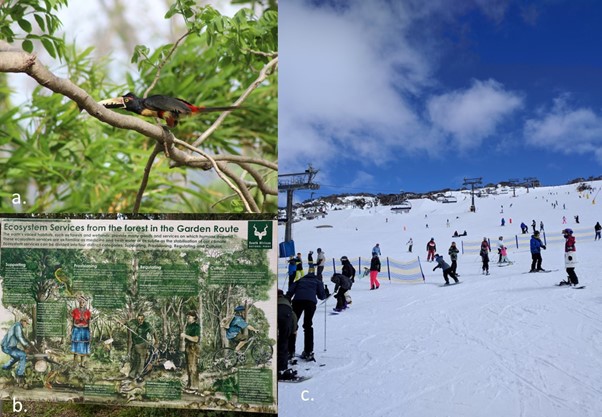
Photography credit: Claudia Múnera-Roldán
By Claudia Munera-Roldan, Mathew J. Colloff, Lorrae van Kerkhoff, and German I. Andrade.
For a long time, we have been setting apart portions of land and oceans to conserve as refuges for biodiversity against human actions. However, climate change forces us to rethink and reimagine our relationship with nature. How can we conserve a snowcapped mountain when the glaciers are no longer there? How can we protect an iconic species when the rainforest it depends upon transforms into a dry woodland? Climate change brings new and inevitable ecological transformations where preserving, maintaining, and restoring to existing or earlier states may no longer be possible. The impacts of climate change are challenging our capacity to conserve biodiversity, including how we prepare and respond to a changing climate. In a nutshell, we need to adapt to climate change. But what does adaptation mean in the context of protected areas?
We interviewed conservation practitioners and scientists from Australia, Colombia, and South Africa to gather and compare their narratives of what adaptation is. We aimed to learn how individuals and institutions understand the impacts of climate change on biodiversity conservation, how such interpretations influence choices for the future, and what the implications are for managing change or preventing climate-related changes in protected areas. We found a diversity of interpretations of adaptation concepts and approaches. The adaptation narratives (the stories used to explain adaptation) differ in the purpose of adapting to climate change (adaptation of what and for whom) and the level of acceptance of ecological change. We also found differences in the response time and the governance approaches that facilitate or constrain the implementation of adaptation.
Drawing from our results, we emphasise the importance of understanding local narratives about the impacts of future climate changes in protected areas and how such narratives can translate into pathways for collective action towards the future.
 Relational Thinking