By Karina Benessaiah, and Kai M. Chan.
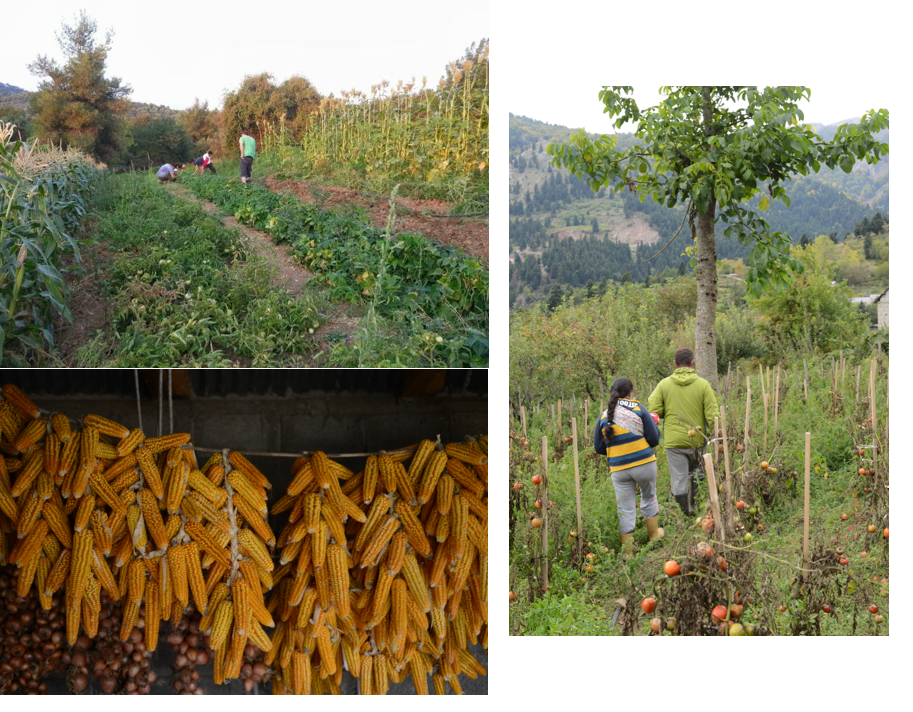
Many people that were previously living in urban areas decided to reconnect to nature by foraging and growing food in rural, peri-urban, and urban areas during the economic crisis in Greece (post-2009). Why? And how does this reconnection make a difference in people’s lives?
In this paper, we asked 76 households that had gone “back to the land” in 2014-2015 to tell us about their experiences reconnecting to the land and the ecosystem benefits they derived. People indicated that reconnecting to the land helped them cope with the crisis, providing food and income at a time when the crisis severely impacted them economically and socially. People relied on previously underutilized ecosystem benefits, such as abandoned lands and wild foraged goods, that are often overlooked in normal circumstances yet provided safety nets in times of crisis. These material ecosystem benefits were crucial for people’s resilience—i.e., their ability to bounce back—and for their material well-being. This points to the need to manage ecosystems for their option value – that is, their potential future uses.
People also emphasized the numerous nonmaterial benefits that helped them cope emotionally and psychologically with the crisis including mental and physical health, feeling safe, calm, and independent. Reconnecting to nature helped people go beyond just bouncing back in a material way; it helped them adapt and transform to the new socio-economic context brought about by the crisis. Reconnecting to nature led people to gain new perspectives, meaning, and relationships with others and the natural world, allowing them to reconceptualize what a good life was about and how to get it. This enhanced their capacity to act and move forward, what has been called agency.
While the crisis significantly affected people’s material well-being, reconnecting with nature allowed them to cope with these new circumstances and prompted a profound reevaluation of what constitutes a good life, leading to changes in their subjective (how they assess their conditions) and relational well-being (how they relate to others and to the land). These material and nonmaterial ecosystem benefits are deeply interconnected and linked to the formation of new individual and collective connections with place and nature. We show that understanding resilience and well-being when reconnecting to nature cannot happen if we solely examine material ecosystem benefits; nonmaterial benefits despite being intangible play an important role in people’s flourishing. Overall, our research emphasizes how reconnecting with nature during crises can have transformative effects on individuals’ resilience, well-being, and relationships with the environment.
 Relational Thinking