By Eberechukwu Johnpaul Ihemezie, José A. Albaladejo-García, Lindsay C. Stringer, and Martin Dallimer
Religious beliefs and culture affect how people perceive life and nature. A change in religious belief often affects how people relate to nature, especially natural landscapes with religious and cultural connotations. This is the case with sacred forests, a landscape protected primarily by indigenous traditional religious beliefs and culture. About 15% of global forestlands have sacred connotations. However, these sacred forests are currently facing existential threats due to the gradual loss of indigenous knowledge, erosion of traditional customs, and diminishing regard for indigenous culture. This implies that relying on a single value system of traditional culture is no longer effective in conserving sacred forests. There is, therefore, a need to identify other multiple values of sacred forests and understand how people differ in their value preferences for sacred forests.
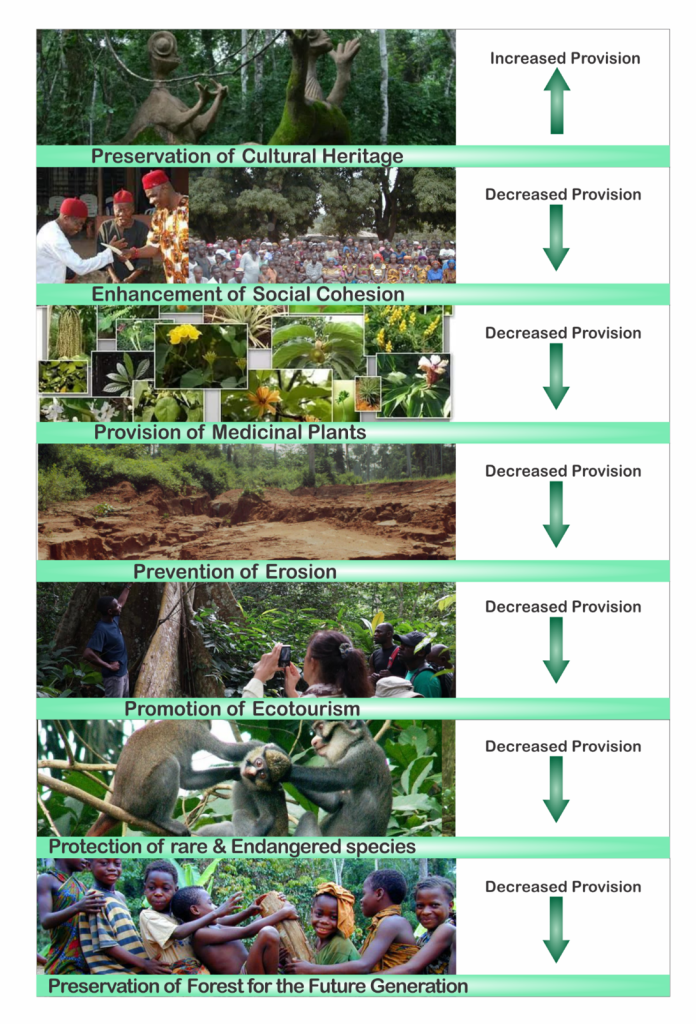
To address these issues, we combined social science approaches using indigenous knowledge and traditional methods to identify multiple values of nature and ascertain which values matter most to the public in sacred forest conservation, from diverse stakeholders in communities living around sacred forests in South-East Nigeria. We found that beyond cultural values, multiple sociocultural values are attributed to sacred forests. For example, people care about medicinal, bequest, ecotourism, environmental, existence, and social values. However, medicinal values are most preferred, while social values are least preferred, indicating a possible shift in how people now perceive and relate to sacred forests from non-material to material value. We also found that the current management strategy that depends solely on cultural values is inadequate, and new strategies are needed to galvanise shared and collective responsibility from diverse stakeholders.
Using a value-based model, we designed robust management strategies that will yield high utility to the public and effectively conserve sacred forests. We believe that incorporating multiple human values in the design of conservation management strategies could help to achieve conservation goals and draw local support for conservation. Overall, this study provides evidence of why it is important to understand the values that people hold regarding forest conservation.
 Relational Thinking