By Rachel White, Lizzie Jones, Lucy Groves, Michael Hudson, Rosalind Kennerley, and Sarah Crowley.
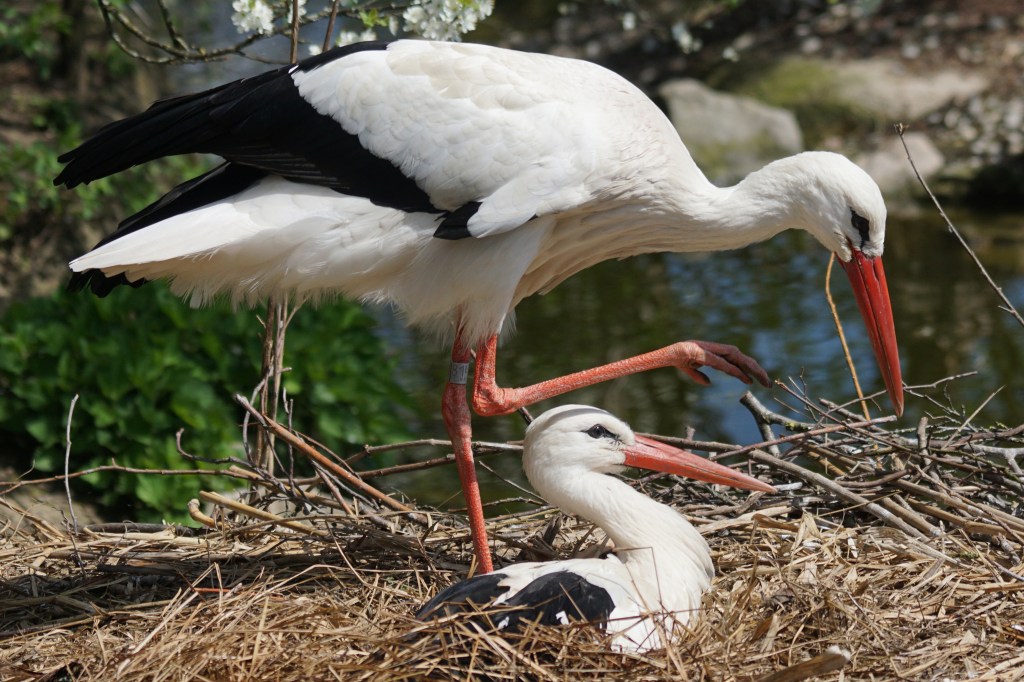
Species reintroductions are an increasingly popular conservation tool, typically aiming to achieve direct conservation benefits, by re-establishing a viable population of the focal species within its native range. In addition to the direct conservation benefits of reintroductions, there are also socio-cultural benefits. However, socio-cultural benefits have, to date, received very little attention in research and policy. As a case study, we focus on the recent and ongoing reintroduction of the White Stork to England, key drivers of which include connecting people with nature, providing local socio-economic benefits, and inspiring environmental restoration.
We surveyed 3531 people in Britain to establish and explore baseline awareness, knowledge and experience of, and attitudes towards, White Storks and White Stork reintroduction. We compared our findings between (i) self-selecting and nationally representative samples, and (ii) residents living close to release sites versus non-locals.
In contrast to self-selecting participants, most of the nationally representative sample had never heard of nor seen a White Stork and were unaware of the reintroduction. Attitudes were more positive in the self-selecting sample and neutral or uncertain in the nationally representative sample.
86% of participants supported the reintroduction overall. Reasons provided for support were diverse, relating to perceived or experienced socio-cultural benefits and values, general biodiversity enrichment, and moral impetus to restore formerly native species. Criticisms, raised by a minority, related to uncertainty/disagreement about the White Stork’s formerly native status; rigour of the ecological risk assessment; and a perceived lack of transparency regarding how the project supports conservation efforts.
The contrast in our findings between engaged communities and wider publics, highlights the importance of surveying both groups when conducting public consultations for reintroductions. It is hoped that this baseline study will form the basis of a long-term monitoring effort to track community and public perceptions over time, whose British range and population size are predicted to increase, and which may result in the establishment of nests in close proximity to people. Given that reintroductions have underexplored potential to (re)establish socio-cultural relationships between people, wildlife and landscapes, and these are increasingly cited as justifications for reintroductions, we encourage further discussion and research in this area.
 Relational Thinking