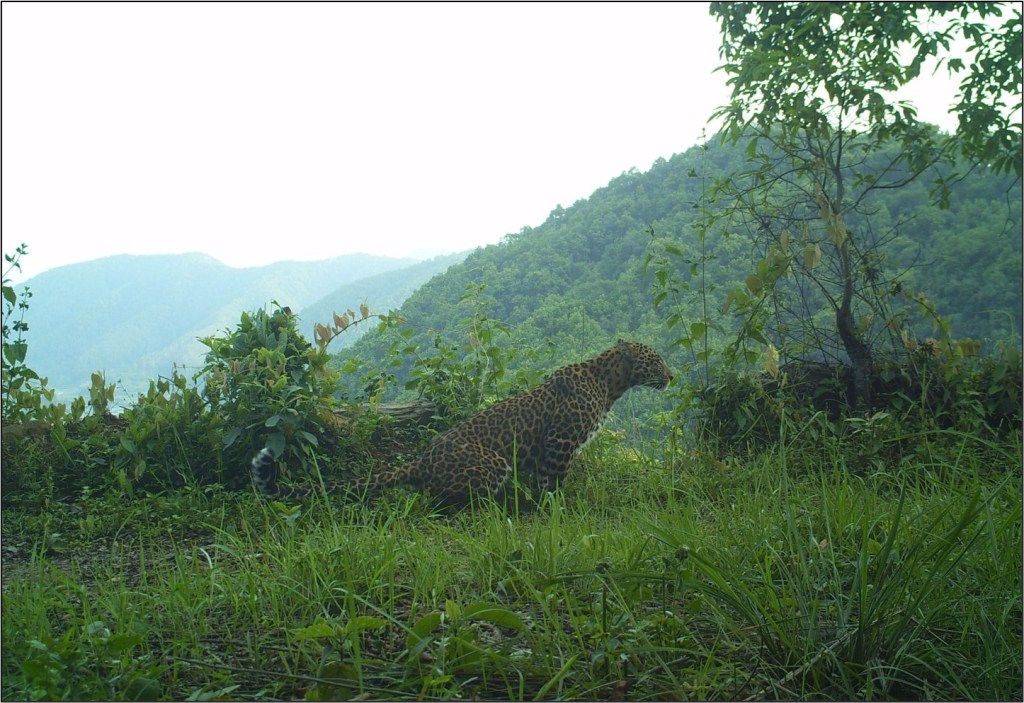
Photo credit: Shashank Poudel/Cornell University.
By Shashank Poudel, Joshua P. Twining, Richard C. Stedman, Shravan Kumar Ghimire, and Angela K. Fuller.
In 2019, a series of leopard attacks on humans, particularly kids under 10 years old started in the district of Tanahu in the west-central mid-hills of Nepal. Between 2014-2018, two other districts further west of Tanahu also faced severe leopard attacks on humans and livestock. These attacks resulted in death or severe injuries. Following the attacks, the Government of Nepal implemented a plan to improve safety by setting up trap cages and rescuing the problem leopards. However, the problem of human-leopard conflict is becoming more widespread in almost all the districts of mid-hills. This led us to think about what in the landscape is driving the leopard attacks on humans.
In our study, we describe drivers of leopard attacks on humans. We collated a five-year dataset from online news websites, extracted important covariates from secondary sources, and modeled the probability of leopard occurrence along with the factors that might be driving the attacks. Methodologically, we used models (occupancy) that allow us to test hypotheses related to leopard attacks and landscape features while accounting for imperfect reporting in publicly available data on human-wildlife conflict.
Leopard attacks on humans in Nepal are more likely to occur in municipalities with high human population density, rugged terrain, and high livestock density. These results not only provide insights into the drivers of leopard attacks on scales meaningful to the management of wildlife populations and conflict, but they also identify critical factors within the landscape that managers could prioritize to address human safety. Our study indicates that common local factors likely determine leopard attacks on humans. These factors include landscape features, anthropogenic prey (livestock), and human density across the landscape. This is the first study in Nepal that predicts drivers of leopard attacks at a landscape scale and has meaningful implications for human-leopard conflict management.
 Relational Thinking