A blog post by Oskar Abrahamsson, Doctoral Student at the School of Business, Economics and Law at University of Gothenburg.
Whilst walking my dog Otto during a dark evening in November, I noticed a lilac bush blooming that evoked an uncanny feeling within me. Lilac flowers are one of my favourites, not the least for its smell, yet for that very encounter the context was wrong: In western Sweden where I live, lilacs bloom in May and June, not in November. For me, this was a clear sign of the ongoing environmental crisis – hence my uneasiness.
This encounter made me think: What if we approached the ongoing disastrous changes of the environment and climate as a relationship crisis? Thinking relationally about humans and environments may precisely entail that, for it compels us to reflect beyond only environmental conservational practices, by pulling us into environmental conversations. For example, Tim Ingold writes that modern society has “forgotten how to correspond” (p. 9) with living beings and other things that surround us. In fact, the word ‘conversation’ stems from to live, dwell, live with, keep company with, and a sustainable co-living require attentive care of the other. For humans to recognise the world as entangled, Anna Lowenhaupt Tsing invites us to cultivate the art of noticing any present lifeform including its way of co-creating the world. For all kinds of relationships, paying attention is thereby key.
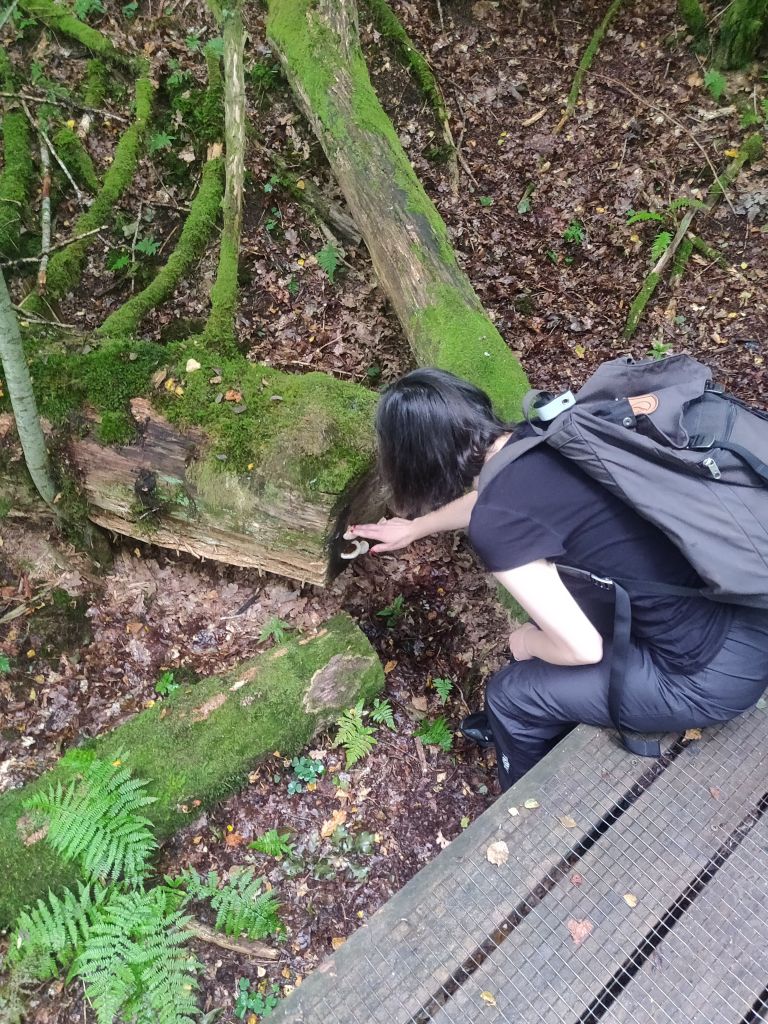
The act of paying attention nonetheless connotes a sense of simplicity, for it is an inherent human ability requiring merely practicing. In my research on single-day recreational walking, I have noticed how important paying attention to the encountered environment is for its joy. Walking in natural environments both dissolves one’s attention from everyday demands and creates spaces for cultivating and deepening the awareness of nonhuman presence, as the walking body moves through places in a slow pace. You can never entirely know what encounters awaiting you along the path – at best, the spontaneity evokes what Rachel Carson once called a sense of wonder; a meaningful moment when abstract facts about the encountered nonhuman is overshadowed by a concrete, curious and empathetic feeling of its immediate presence and appearance.
If considering the critical condition of the environmental crisis, one may object that moments of mere wonder is too naïve and too ineffective, right? You who are reading this may, after all, think that what we really need today are global and radical measures that reduce greenhouse gases emissions and further exploitation of ecosystems, and perhaps not a mindfulness exercise whose impact we cannot calculate. Yes, ceasing humans’ environmentally harmful behaviours is exactly what we need. Yet, directing our attention towards the immediate environment and thereby noticing its multiplicity of life can be the most radical one can do – for at the same time, the degrading system is challenged by with minor effort.
Shoshana Zuboff has argued that our attention directed towards companies’ digital products, services, apps and websites is the 21st century global economy’s new raw material; alongside the exploitation of material resources from ecosystems and work from human labour, human attention has now also become a subject of capitalisation. Consequently, human awareness of the ever-present environmental relationships we partake in erodes by our inattention of the immediate milieu – and a relationship lacking attention will eventually turns into a crisis.
To answering the question imposed by the title of this blog post: No, I do not believe that there can be any healthy relationship without attentive conversations – if one acknowledges dialogue by its broadest understanding. Can walking, as exemplified above, be a cure for healing the broken conversations with more-than-human lifeforms? Yes, I think there is some truth in that, if one are willing to noticing the vibrancy surrounding us (even when walking in a city(!)) and letting the impressions linger within us.
Although being simple, paying attention can be hard practice. Particularly nowadays when sensual experiences are absorbed by commercial forces; many of us – including myself – recurrently escape the immediate presence by attending to alluring visual and audial conversations mediated from elsewhere. The take-home message, after all conveyed by this mediated blog post, is that for your next outdoors roam – in any kind of environment – try paying attention by all your senses to the myriad of life that surrounds you. From there, allow yourself to tune in to those conversations. As such, let the impressions you gather during your outings be fashioning your forthcoming gentle expressions, both as talk and action.
If you would like to write a post for Relational Thinking, please get in touch with editorial@people-and-nature.org with a short pitch.
 Relational Thinking