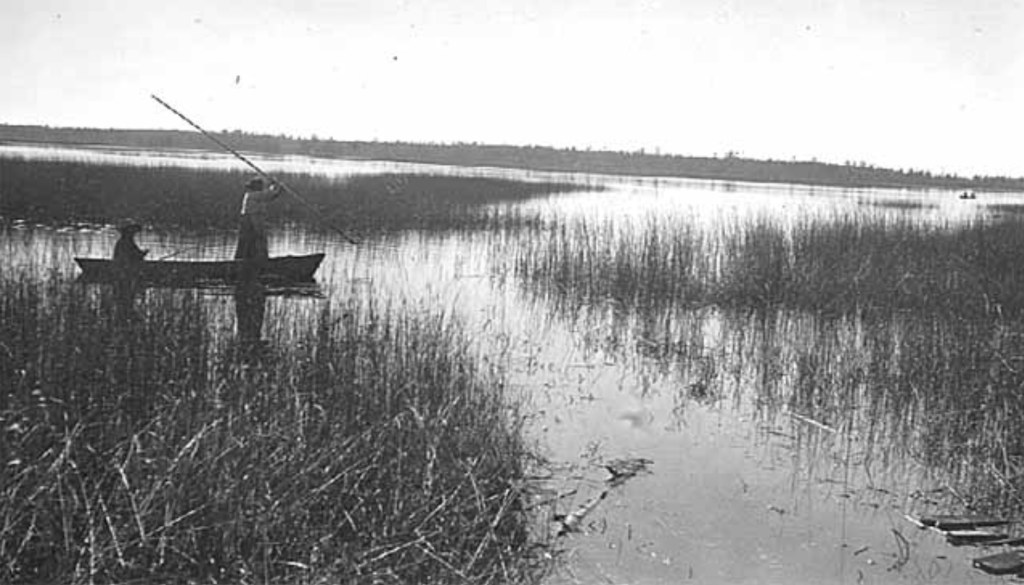
Photo: Minnesota Historical Society.
By Priscilla Wehi, Katie Kamelamela, Kyle Whyte, Krusihl Watene, and Nicholas Reo.
Read the full paper here.
Humans move species around the world and these species may spread and become invasive. Invasive species can threaten and outcompete other species living in those areas. They can also affect the resilience of ecosystems and even economic stability. Thus, eradicating invasive species is often seen as the first or most important action to take to restore an ecosystem. But it may not be feasible to eradicate invasives for a variety of reasons. Increasingly, researchers recommend that managers need to think carefully about both the positive and negative impacts of invasive species before they act.
We argue that centering Indigenous management frameworks promises to strengthen overall management responses and outcomes because they also attend directly to human and environmental justice concerns. Indigenous frameworks are relational, and biocultural, and support just outcomes for communities. These frameworks emphasise relatedness, for example, of different forms of life, and the importance of respect. They ask questions that focus on the behaviour of invasive species within a relational framework.
We also unpack the origins of the dominant ‘introduced species paradigm’ to understand how the terminology of ‘aliens’ and ‘natives’ that is often used in biology recalls harmful histories and alienates Indigenous stewardship. Using these words and framings may limit application of Indigenous frameworks and management, because they remind people of past injustices such as the removal of communities from their lands, and impose unwelcome ideas and categorisations that may not fit with Indigenous philosophies. If communities feel alienated from species and ecosystem management, this can create barriers to the successful long-term protection of plants, animals, and other forms of life. Instead, we suggest that centering Indigenous Peoples’ biocultural practices to invasive alien species can protect the relationships of humans with other species and our obligations to them, and also realise justice for communities. We therefore argue for a pluralistic vision that acknowledges multiple alternative Indigenous relationships and responses to invasive species which can contribute to vibrant futures where all elements of society, including kin in the natural world, are able to flourish.
 Relational Thinking