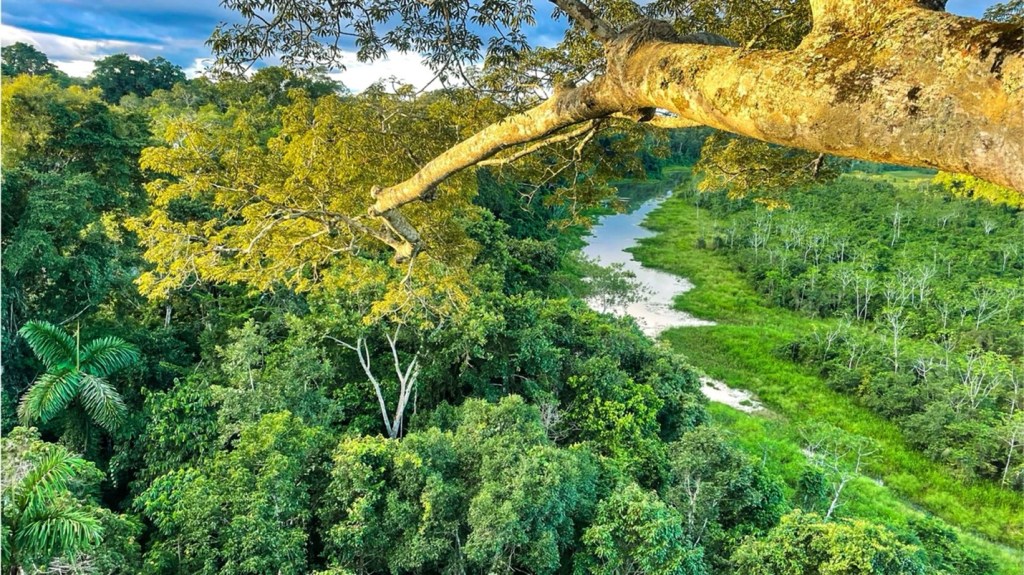
The photo was taken in 2021 by Mark Bush (author), while he and Crystal McMichael (author)
collected paleoecological samples to look at ecological legacies within the forest.
By Crystal McMichael, Mark Bush, Juan Jiménez, and William Gosling.
Amazonia is the largest rainforest in the world and holds a large part of Earth’s biodiversity and terrestrial carbon stocks. Over 400 group of indigenous people also live in Amazonia. Traditional views held Amazonia as a ‘pristine’ forest that had almost no human impact prior to the arrival of European colonists around 1540. Archaeological and paleoecological research has shown, however, that this is not the case, and that complex societies flourished in many regions of the forest.
For millennia, indigenous people have modified soils, cultivated land, and altered the abundances of many useful plants. One can still see signs of many of these activities in the forest today. These ‘ecological legacies’ have thus persisted in the forest for hundreds or thousands of years, helping shape what the forest is today.
Amazonia is currently under threat from global climate change and other pressures like urbanization and fire that are happening at an unprecedented scale. In this perspective article, we highlight how indigenous people’s ecological legacies over the last centuries to millennia have likely increased forest resilience to drought and fire events. We suggest this process occurs because successional trajectories following land abandonment, which takes hundreds of years because of the long lifespan of Amazonian trees, favor plants with traits that are more tolerant to disturbances. We outline the processes through which this localized increase in forest resilience likely occurs and recommend steps in future research that can further integrate data that link past processes with modern ecological states.
 Relational Thinking