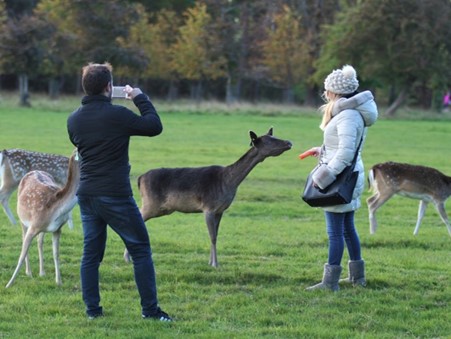
(Photo credit: Laura L. Griffin).
By Laura Griffin, Grace Nolan, Amy Haigh, Hannah Condon, Ellen O’Hagan, Paul McDonnell, Adam Kane, and Simone Ciuti.
Read the full paper here.
This study aimed to assess how different management scenarios can impact the number of people feeding wild animals; a form of human-wildlife interaction that can be risky for both the humans and wildlife involved. Current management methods, such as signs and posters, have had some positive results in reducing the number of people feeding wildlife in public green spaces. However, the effects of interruptions to management, such as was caused by the COVID-19 pandemic, are currently unknown. The goals of this study were two-fold:
- To assess changes in the numbers, if any, of visitors feeding wild animals in a popular urban green space during the COVID-19 pandemic.
- To test media campaigns, which are commonly used in conservation marketing, as a potential tool in reducing the number of people feeding wildlife– both after an interruption to management and in general.
We performed a four-year study using a wild fallow deer population in a popular urban parkland as our model system. We tracked changes in the numbers of people offering deer food across four management stages: pre-management, during traditional management (i.e. signage), mid-interruption (i.e. the COVID-19 pandemic), and during the application of a structured media campaign. We found that feeding by visitors decreased during traditional management, but rapidly returned to pre-management levels during the interruption despite the signage still being in place. However, feeding dropped significantly after the release of the media campaign, despite the audience and conditions being the same as during the pandemic stage of assessment. We, therefore, recommend that wildlife managers further explore the potential for media campaigns to aide in the reduction of feeding, therefore promoting better human-wildlife coexistence. We also suggest that managers be aware of the potential negative impacts that the COVID-19 pandemic, as well as other interruptions, may have had on ongoing management campaigns. We recommend that future studies assess which specific media tools are most effective, and apply visitor surveys to assess direct effects. This study marks the first of its kind, and highlights the importance of ongoing monitoring and management to reduce human-wildlife feeding interactions in all impacted sites.
 Relational Thinking