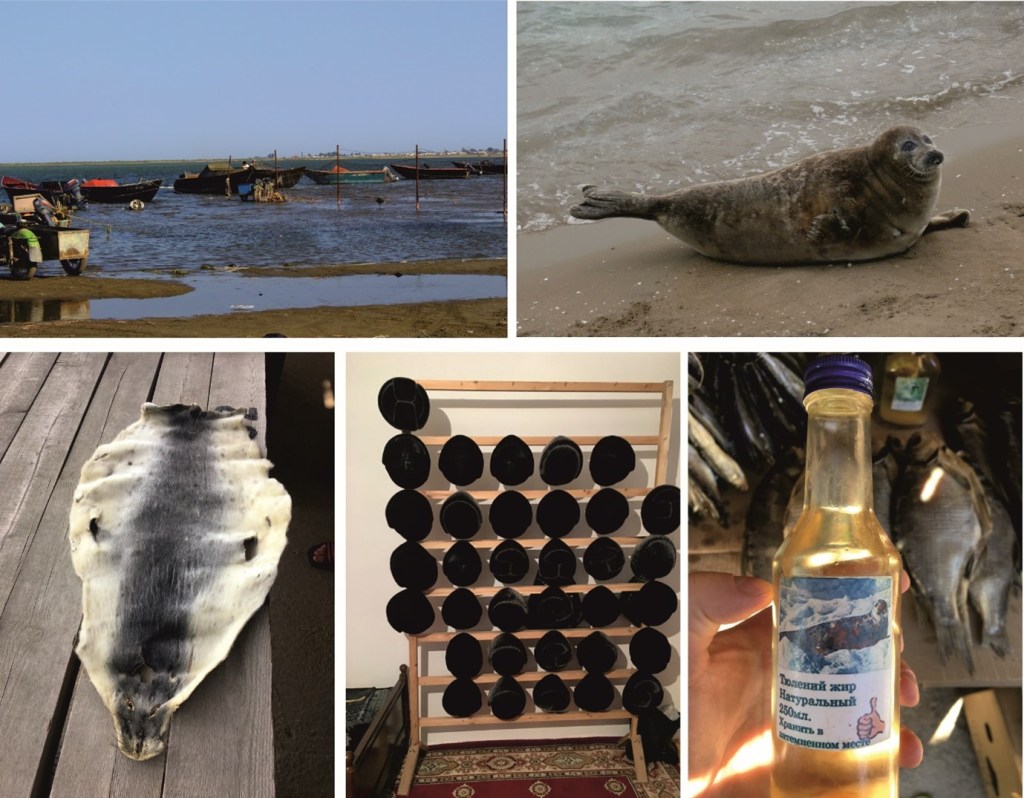
A Fishing quay in Sulak, Dagestan, summer 2013. Image Dr. Linas Svolkinas;
Adult Caspian seal (Pusa caspica). Image credit Dr Pavel Erokhin;
Vendor trade stall trading a seal pelt, Dagestan, July, 2018. Image Dr. Linas Svolkinas;
Seal fur hats, furrier workshop in Dagestani highlands, July, 2018. Image Dr. Linas Svolkinas;
Vendor trade stall selling bottled medicinal oil from Caspian seals, Makhachkala, Dagestan, July, 2018. Image Dr. Linas Svolkinas.
By Linas Svolkinas, George Holmes, Lilia Dmitrieva, Ilya Ermolin, Pavel Suvorkov, and Simon Goodman.
Read the full paper here.
Globally, large numbers of marine mammals are entangled and drowned in fishing gear every year. Much of this mortality is associated with illegal and unregulated fishing (i.e. fishing carried out without appropriate licensing or in violation of other fishing rules), in small-boat artisanal fisheries. To help make such fisheries more sustainable, there is a need to find ways to motivate fishers to stop illegal and unsustainable practices. Yet, illegal fishing provides fishers income and fisheries regulation often has complex social dimensions, including the involvement of organised crime, making it challenging to develop effective policies.
Therefore, to reduce illegal fishing and trade, it is important to engage with local fishing communities, instead of focusing entirely on top-down law enforcement. However, it remains unclear which community-led interventions might be most effective and how to develop them. A key step in solving this issue is to understand community viewpoints regarding illegal fishing and its solutions.
An important artisanal fishery with high rates of illegal activity is the targeting of sturgeon for caviar and meat in the Caspian Sea, by coastal communities in Dagestan, Russian Federation. This fishery is has pushed Caspian sturgeon to the brink of extinction, and it also associated with high rates of bycatch of endangered Caspian seals.
To explore potential solutions to the illegal fishing and seal bycatch issues in this region, we used the ‘Q method’, which asks community participants to sort short statements on conservation issues depending on their views on each statement. An analysis of the responses then identifies groups of participants based on the similarity of their attitudes toward different issues, and where there are areas of consensus and divergence on key points.
During the autumn of 2018, we conducted 50 interviews with illegal fishers and traders of Caspian seal products (fur and oil). Our analysis of consensus suggests that fishing communities are willing to reduce participation in illegal fishing given appropriate support. We found a strong desire for alternative livelihoods and improved sustainability. There was strong agreement on the potential effectiveness of marine protected areas and that increased regulation might be supported by fishers if implemented. This provides some optimism that it could be possible to find lasting solutions to illegal fishing in the Caspian that will be supported by local communities.
 Relational Thinking